
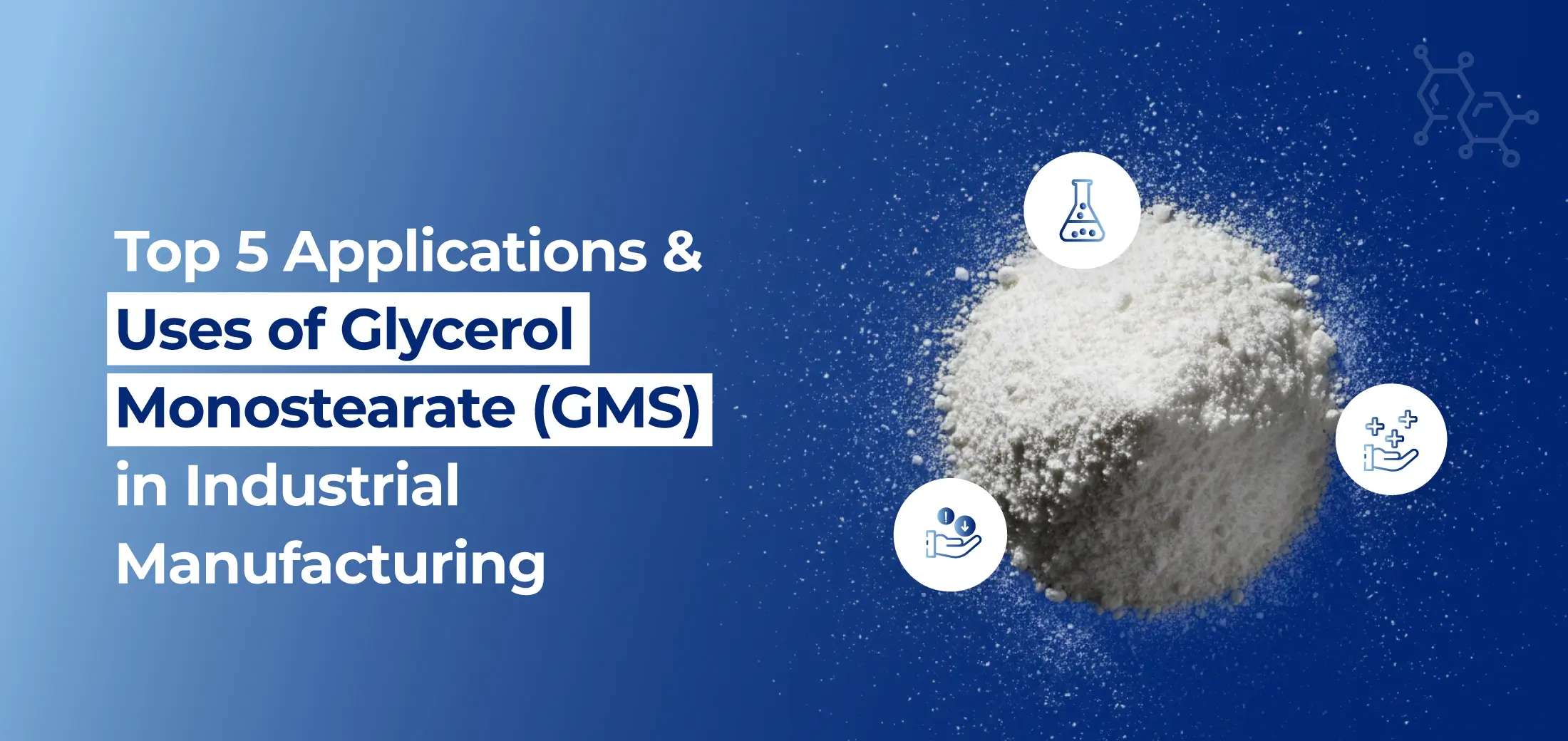
Glycerol Monostearate (GMS) is a versatile chemical additive with a wide range of industrial applications. Produced by reacting glycerol with stearic acid, GMS is a white, odorless compound known for its emulsifying, lubricating, and stabilizing properties. Beyond its well-known uses in food and personal care, GMS plays valuable roles in industrial manufacturing processes where efficiency, surface quality, and product performance matter.
In this blog, we explore the top 5 industrial applications and uses of Glycerol Monostearate and why it's a preferred additive across various manufacturing sectors.
1. Plastics & Polymer Processing
GMS is widely used in the plastics industry as a processing aid, lubricant, and anti-static agent. It helps improve flowability and reduce friction during polymer extrusion and molding, leading to smoother operations and superior surface quality in final products. GMS also helps reduce static buildup, which can be problematic in the production of thin films and precision plastic parts.
Key industrial benefits:
- Enhances melt flow and reduces viscosity during processing
- Acts as an internal lubricant for easier mold release
- Reduces static electricity and prevents tackiness
- Improves surface finish of plastic products
This makes GMS ideal for manufacturing PVC products, plastic films, sheets, and molded components where quality and efficiency are critical.
2. Textile Finishing & Fabric Processing
In the textile industry, GMS serves as an effective softener and antistatic agent. It helps reduce friction and static charge in synthetic fibers, making fabrics easier to handle and process. GMS also imparts a soft feel and improves the finish of textiles, which enhances the quality and comfort of the fabric in end-use applications.
Industrial applications in textiles include:
- Softening treated finishes on fabrics
- Reducing static during fiber spinning and weaving
- Improving ease of handling and reduced breakage
3. Coatings, Paints & Inks
GMS plays a key role as a dispersing and stabilizing agent in coatings, paints, and printing inks. It helps distribute pigments uniformly and prevents particle agglomeration, leading to consistent color, improved opacity, and better overall coating performance. GMS can also improve the rheological properties of formulations, contributing to smoother application and enhanced film properties.
Benefits in surface coatings:
- Enhances pigment dispersion and color uniformity
- Improves surface smoothness and film stability
- Supports better application and drying characteristics
This makes GMS suitable for industrial paints, automotive coatings, and high-performance printing inks.
4. Rubber & Elastomer Manufacturing
In rubber processing, Glycerol Monostearate acts as a processing aid and lubricant, helping reduce internal friction during mixing and molding. By improving dispersion of fillers and additives, it helps achieve more uniform rubber compounds. GMS also facilitates easier release from molds and can improve the surface finish of rubber parts.
Industrial advantages in rubber:
- Improves compound flow and homogeneity
- Reduces sticking and mold adhesion
- Enhances surface quality of molded rubber parts
Applications include the production of automotive rubber components, seals, hoses, and various molded products.
5. Lubricants & Specialty Additives
GMS finds use in industrial lubricants and specialty additive formulations thanks to its lubricity and stabilizing effects. It can improve the film-forming properties of greases and metalworking fluids, helping reduce wear and friction in heavy machinery components. In addition, GMS's stabilizing properties make it useful in wax and resin formulations used in various industrial processes.
Industrial uses include:
- Enhancing lubrication in metalworking fluids
- Improving consistency in wax and resin blends
- Acting as a stabilizer in complex formulations
Why GMS Is Valuable in Industrial Manufacturing
Glycerol Monostearate's multifunctional nature — combining emulsification, lubrication, anti-static action, and stabilization — makes it a staple in modern industrial manufacturing. It helps streamline processing, improve product quality, and reduce defects across sectors such as plastics, textiles, rubber, coatings, and lubricants.
At Nimbasia Stabilisers, we deliver high-quality Glycerol Monostearate tailored to industrial needs, ensuring consistent performance and reliability for your manufacturing applications. Whether you're optimizing polymer processing, enhancing coating formulations, or improving lubricant performance, GMS from Nimbasia helps you achieve superior results.
Conclusion
From enhancing plastics processing and textile finishes to boosting the performance of coatings and lubricants, Glycerol Monostearate is a versatile additive that supports efficiency and quality in industrial manufacturing. Its ability to improve product properties, processing behavior, and surface outcomes makes it a valuable component in numerous manufacturing processes.
Choose Nimbasia Stabilisers for premium-grade Glycerol Monostearate that delivers performance, purity, and consistency for your industrial production needs.