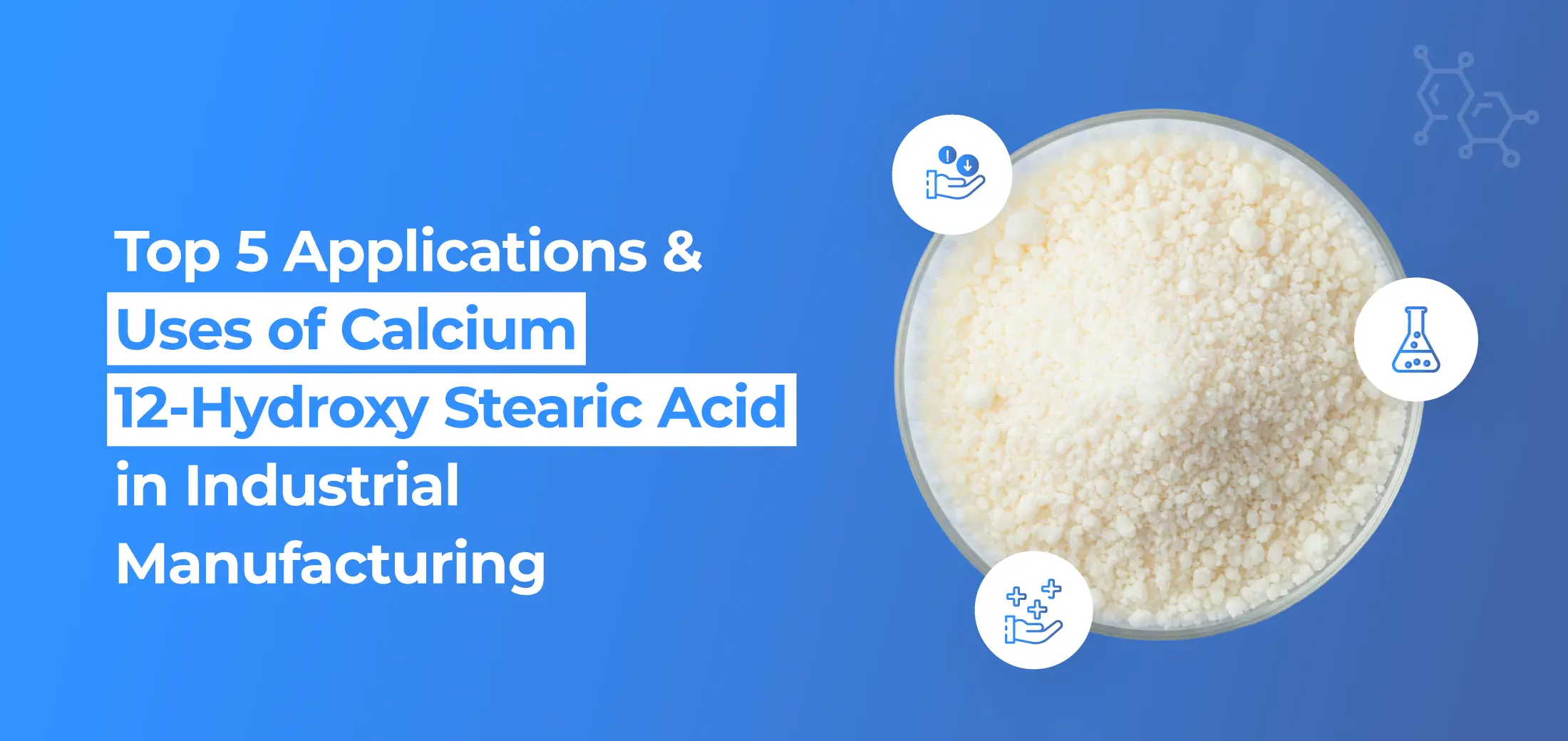
Calcium 12-Hydroxy Stearic Acid is a metallic salt derived from 12-Hydroxystearic Acid (12-HSA), which itself is produced from hydrogenated castor oil. According to Nimbasia Stabilizers, the calcium variant is supplied as a white or off-white waxy/solid powder, with properties tailored for industrial use — including stability, compatibility with oils and resins, and effective lubricating or stabilizing behavior.
Chemically, 12-HSA carries a long hydrocarbon chain with a hydroxyl (-OH) group at the 12th carbon. When converted into a calcium salt, Ca 12-HSA retains the beneficial properties of 12-HSA — such as hydrophobicity, thermal stability, and compatibility with oils and resins — while gaining the advantages of a metallic soap (calcium salt), making it suitable as a stabilizer, lubricant, dispersant or release agent in industrial formulations.
Because of these attributes, Ca 12-HSA finds widespread usage across plastics, rubber, lubricants/greases, coatings, and specialty industries (e.g. cosmetics, adhesives).
Why Calcium 12-HSA is Valuable in Industrial Manufacturing
Before diving into applications, it helps to understand what makes Ca 12-HSA attractive:
- It offers stabilizing and dispersing capabilities — particularly useful in polymer, paint, and coatings formulations where uniform dispersion of fillers/pigments matters.
- It acts as a lubricant, internal or external, or release agent, which simplifies processing (e.g. molding, extrusion) by reducing friction and preventing sticking — especially valuable in plastics, rubber, and metal molding.
- Its compatibility with oils, resins, waxes, and many organic materials makes it versatile across formulations — from greases to coatings to adhesives.
- As a metallic soap (calcium salt of a fatty acid), it helps in building structure (as in greases), stabilizing emulsions, and improving thermal/mechanical performance of final products.
- It supports environmentally conscious or bio-based product strategies, being derived from castor oil — a plant-based feedstock — which can appeal to industries seeking sustainable raw materials.
Given these advantages, Ca 12-HSA becomes a go-to additive for many manufacturers optimizing performance, durability, and process efficiency.
Top 5 Industrial Applications & Uses of Calcium 12-HSA
Here are the five major application sectors where Ca 12-HSA proves most valuable:
1. Lubricants & Grease Manufacturing
One of the foremost applications of Ca 12-HSA is in the production of calcium-based greases and lubricants. As part of the metallic soap family of additives, Ca 12-HSA helps form a stable soap-oil matrix that thickens base oils and ensures consistent grease performance.
Why Ca 12-HSA is ideal for greases:
- It provides good structural stability — the soap network retains base oil, avoiding separation and ensuring uniform consistency over time and varying temperatures.
- It offers water resistance and adhesion — crucial for greases used in environments exposed to moisture, such as agricultural machinery, water pumps, bearings, chassis parts, and mining equipment.
- It delivers shear stability and pumpability, making it suitable for both heavy-duty industrial greases and multipurpose lubricants.
Because of these features, manufacturers of automotive greases, industrial lubricants, marine machinery lubricants, and general-purpose maintenance greases frequently use Ca 12-HSA as a core thickener/stabilizer.
2. Plastics & Polymer Processing (PVC, Plastics, Resin Systems)
In plastic and polymer manufacturing — especially PVC and other resin-based products — Ca 12-HSA is valuable as a processing aid, lubricant, stabilizer, and release agent. As noted in industry sources, 12-HSA (and salts) help in improving melt flow, reducing friction, and smoothing mold release in injection molding or extrusion processes.
Benefits in plastics processing:
- Acts as an internal/external lubricant, decreasing die-wall friction and facilitating smoother melt flow.
- Functions as a release agent, making demolding easier and reducing defects or sticking in molded parts.
- Provides stabilization during heat-intensive processes — important for PVC and other thermoplastics sensitive to degradation. The metallic soap nature helps neutralize acidic byproducts and maintain polymer integrity.
- Enhances surface finish and dimensional stability in final plastic products — films, sheets, profiles, or molded components benefit from improved gloss, lesser surface flaws, and consistent quality.
Hence, plastic manufacturers — especially those producing PVC pipes, sheets, profiles, molded parts — can benefit significantly by incorporating Ca 12-HSA in their formulations.
3. Rubber & Elastomer Industry
The rubber industry (natural and synthetic rubber) also leverages Ca 12-HSA as an effective processing aid, internal lubricant, and vulcanization assistant. The general 12-HSA chemistry lends itself to improving rubber compounding, mixing, molding, and curing processes.
How Ca 12-HSA helps in rubber manufacturing:
- Acts as an internal lubricant, reducing friction during mixing and extrusion of rubber compounds — easing filler dispersion (e.g. carbon black, silica) and enabling uniform mixing.
- Helps as a flow modifier and processing aid, facilitating molding or extrusion of rubber parts by improving flow under heat and pressure.
- Can function as a vulcanization activator or stabilizer, improving cross-linking efficiency and resulting in rubber with better elasticity, strength, and durability.
- Enhances surface finish and consistency in final rubber products — useful for tires, hoses, sealing elements, belts, gaskets, and molded rubber parts.
For rubber product manufacturers aiming at high-performance, long-lasting rubber goods — including automotive, industrial rubber parts, or consumer rubber items — Ca 12-HSA offers tangible processing and performance benefits.
4. Coatings, Paints, Inks, Adhesives & Sealants
Ca 12-HSA also plays a strong role in the formulation of coatings, paints, printing inks, adhesives, sealants, and related specialty chemical products. As a dispersing/stabilizing and rheology-modifying agent, it helps achieve uniformity, good flow, stable films, and enhanced final properties.
Key advantages in coatings and related applications:
- Acts as a dispersing/stabilizing agent for pigments and fillers — ensuring uniform color, preventing settling, and improving shelf life of formulations.
- Improves rheology and flow behavior, aiding smooth application — whether for paints, varnishes, inks, or adhesives.
- Enhances film formation, gloss, durability, and chemical/water resistance of coatings — suitable for industrial coatings, protective paints, decorative coatings, automotive surfaces, and metal finishes.
- Useful in hot-melt adhesives, sealants, and specialty resins, where its waxy, hydrophobic nature helps in thermal stability, adhesion, and long-term durability.
Thus, manufacturers of paints, industrial coatings, printing inks, adhesives, sealants, and specialty resins frequently rely on Ca 12-HSA to improve product quality, consistency, and performance.
5. Specialty Applications: Cosmetics, Personal Care, Waxes, Polishes, Paper, Packaging & More
Beyond heavy industrial uses, Ca 12-HSA (and 12-HSA in general) finds varied applications in specialty and consumer-facing sectors — leveraging its compatibility with oils, waxes, resins, and its waxy, fatty-acid nature.
Some versatile specialty uses include:
- Cosmetics & personal care: 12-HSA serves as an emulsifier, thickener, stabilizer, and emollient in creams, lotions, lipsticks, deodorants, etc. When in calcium salt form, formulations may benefit from modified texture or stability (depending on intended product design).
- Waxes, polishes, and surface finishes: Its waxy nature and compatibility with oils make it suitable for polishes, wax blends, protective coatings for surfaces (floors, metals), and specialty wax products.
- Paper & packaging coatings: Ca 12-HSA (or its derivatives) may serve as a dispersant or lubricant in paper-coating formulations — helping with gloss, water resistance, smoothness, and printability.
- Adhesives & hot-melt systems: As mentioned earlier, in adhesives and sealants — including hot-melt adhesives — Ca 12-HSA enhances melting behavior, thermal stability, adhesion, and final bond durability.
- Eco-friendly or bio-based material design: Given its origin from castor oil, formulations using Ca 12-HSA can align with sustainable or “green chemistry” goals — appealing in markets for environmentally conscious products.
While not all such applications are as large-scale as plastics or lubricants, the flexibility of Ca 12-HSA makes it a valued additive across diverse sectors, from heavy industry to consumer products.
Additional Benefits of Using Calcium 12-HSA in Industrial Manufacturing
Using Ca 12-HSA delivers broader advantages beyond just functional performance:
- Broad compatibility : Works well with oils, waxes, resins, polymers — making it a “universal” additive for many formulations.
- Cost-effectiveness : Relatively low-cost raw material (derived from castor oil) that imparts multiple functional benefits; reduces reliance on multiple different additives.
- Stability & performance under stress : Provides thermal stability, water resistance, black fill stability, and consistency even under harsh manufacturing or service conditions.
- Sustainability potential : Being bio-based (castor derived), it aligns with sustainable manufacturing and reduces reliance on purely petrochemical additives.
- Versatility across sectors : From heavy-duty lubricants and plastics to cosmetics and packaging — one material can serve many industries, simplifying procurement and inventory management.
These make Ca 12-HSA a strategic choice for manufacturers who need reliable, multi-functional additives that deliver consistent performance.
Why Choose Nimbasia's Calcium 12-HSA
Nimbasia Stabilizers — recognized for high-quality metallic stearates and 12-HSA salts — offers Calcium 12-HSA as part of its product portfolio.
Here's why sourcing from Nimbasia is advantageous:
- Their products meet rigorous industrial-grade specifications ensuring purity, stability, and consistent performance in demanding applications.
- They produce multiple 12-HSA salts (calcium, zinc, magnesium, lithium), giving manufacturers choice and flexibility depending on application needs (lubrication, stabilization, etc.).
- Their materials are suitable for a wide set of industries — plastics, rubber, coatings, lubricants, adhesives, cosmetics — which simplifies sourcing for diversified manufacturers.
- Given the origin from castor oil and compatibility with sustainable practices, their Ca 12-HSA fits well into eco-conscious manufacturing strategies.
Summary: Ca 12-HSA — A Versatile Workhorse for Modern Industry
In conclusion, Calcium 12-Hydroxy Stearic Acid stands out as a versatile, multi-functional additive with applications across a broad spectrum of industrial manufacturing sectors — from heavy-duty greases and lubricants to plastics, rubber, coatings, adhesives, paper, and even specialty consumer products.
Its combination of lubrication, stabilization, release/processing-aid, compatibility, and cost-effectiveness makes it a valuable raw material to optimize performance, increase durability, and simplify formulations. When sourced from a reliable manufacturer like Nimbasia, Ca 12-HSA becomes a dependable component in any industrial raw material inventory.
If you are involved in plastic processing, rubber compounding, grease manufacturing, coatings, adhesives, or specialty formulations, integrating Calcium 12-HSA into your raw-material mix could enhance processing efficiency, improve final product properties, and reduce production issues — helping you deliver better quality products at scale.