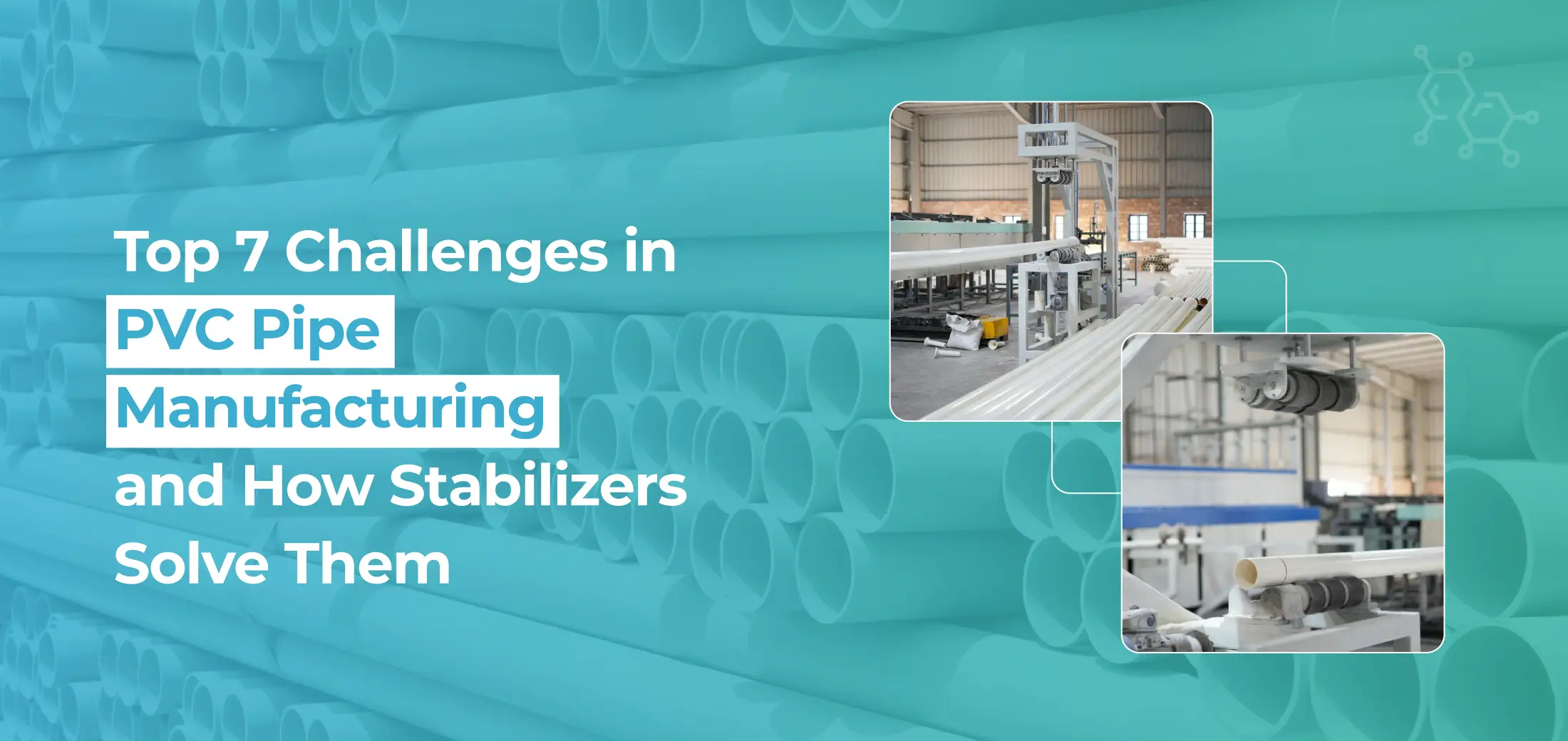
PVC pipes have become an essential component in modern infrastructure, serving applications ranging from water supply and irrigation to drainage systems and industrial piping. Their durability, corrosion resistance, and cost-effectiveness make them one of the most widely used piping materials worldwide.
However, manufacturing high-quality PVC pipes is not without challenges. Pipe manufacturers must maintain consistent product quality while optimizing production efficiency, meeting regulatory standards, and controlling costs. Even minor processing issues can lead to defects, reduced performance, and increased rejection rates.
This is where PVC stabilizers play a crucial role. Modern stabilizer systems help manufacturers overcome common production challenges while improving pipe quality, durability, and processing performance.
Understanding these challenges and the role of stabilizers can help manufacturers achieve more reliable and efficient PVC pipe production.
Why PVC Stabilizers Are Essential in Pipe Manufacturing
PVC is inherently sensitive to heat during processing. During extrusion, the material is exposed to elevated temperatures that can trigger degradation, discoloration, and loss of mechanical properties.
PVC stabilizers help by:
- Preventing thermal degradation
- Improving processing stability
- Enhancing product durability
- Maintaining color consistency
- Supporting long-term performance
- Increasing manufacturing efficiency
These benefits make stabilizers one of the most important additives in PVC pipe formulations.
Challenge 1: Thermal Degradation During Processing
One of the most common challenges in PVC pipe manufacturing is thermal degradation caused by high processing temperatures.
When PVC degrades, manufacturers may experience:
- Yellowing or discoloration
- Reduced mechanical strength
- Poor surface quality
- Increased scrap generation
How Stabilizers Solve This
Advanced PVC stabilizers provide excellent heat stability by protecting the polymer structure during extrusion.
Benefits include:
- Improved thermal resistance
- Longer processing windows
- Reduced degradation
- Consistent product quality
This allows manufacturers to maintain efficient production without compromising pipe performance.
Challenge 2: Inconsistent Pipe Color and Appearance
Color inconsistency can significantly affect product quality and customer perception.
Common issues include:
- Yellowing
- Black specks
- Uneven color distribution
- Surface discoloration
How Stabilizers Solve This
High-quality stabilizers improve color retention throughout processing and storage.
Advantages include:
- Consistent pipe appearance
- Better whiteness retention
- Reduced discoloration
- Enhanced product aesthetics
This is particularly important for premium PVC pipe products and export markets.
Challenge 3: Poor Long-Term Durability
PVC pipes are expected to perform reliably for decades under varying environmental conditions.
Without proper stabilization, manufacturers may encounter:
- Premature aging
- Reduced impact strength
- Cracking over time
- Shortened service life
How Stabilizers Solve This
Modern stabilizer systems help maintain the structural integrity of PVC throughout its lifecycle.
Benefits include:
- Improved durability
- Better aging resistance
- Enhanced mechanical properties
- Extended service life
This contributes to greater customer satisfaction and reduced maintenance costs.
Challenge 4: Processing Instability and Production Downtime
Extrusion instability can lead to fluctuations in pipe dimensions, production interruptions, and inconsistent output quality.
Typical symptoms include:
- Melt instability
- Variable extrusion rates
- Production stoppages
- Increased machine adjustments
How Stabilizers Solve This
PVC stabilizers improve processing consistency and support smooth material flow.
Advantages include:
- Stable extrusion performance
- Reduced downtime
- Higher production efficiency
- Consistent output quality
This helps manufacturers improve productivity and maximize throughput.
Challenge 5: Surface Defects and Poor Finish
The surface quality of PVC pipes directly impacts both performance and appearance.
Common defects include:
- Rough surfaces
- Die lines
- Surface streaks
- Poor gloss
How Stabilizers Solve This
Proper stabilizer systems contribute to smoother processing and improved surface characteristics.
Benefits include:
- Better surface finish
- Improved appearance
- Reduced defects
- Enhanced customer acceptance
A high-quality surface finish often reflects superior manufacturing standards.
Challenge 6: Weathering and Environmental Exposure
Many PVC pipes are exposed to harsh outdoor environments, including sunlight, moisture, and fluctuating temperatures.
These conditions can cause:
- Discoloration
- Material degradation
- Reduced impact strength
- Performance deterioration
How Stabilizers Solve This
Advanced stabilizers help improve weatherability and environmental resistance.
Advantages include:
- Better UV resistance
- Enhanced outdoor performance
- Improved color stability
- Longer product lifespan
This is particularly important for infrastructure and agricultural applications.
Challenge 7: Meeting Regulatory and Sustainability Requirements
Regulatory requirements are becoming increasingly stringent worldwide, particularly regarding environmental safety and sustainability.
Manufacturers must address:
- Compliance standards
- Environmental regulations
- Product safety requirements
- Sustainable manufacturing goals
How Stabilizers Solve This
Modern Calcium-Zinc Stabilizers offer a lead-free alternative that supports regulatory compliance and sustainability initiatives.
Benefits include:
- Environmentally friendly formulations
- Regulatory compliance
- Improved workplace safety
- Greater market acceptance
This helps manufacturers meet evolving customer and industry expectations.
How Different Stabilizers Support PVC Pipe Manufacturing
Calcium-Zinc stabilizers have become increasingly popular due to their environmental and performance advantages.
Key benefits include:
- Lead-free formulation
- Excellent thermal stability
- Improved weather resistance
- Regulatory compliance
- Enhanced sustainability
Traditionally used in PVC pipe production, lead stabilizers offer:
- Good thermal stability
- Cost-effective processing
- Established performance history
However, environmental concerns have accelerated the shift toward lead-free alternatives.
These stabilizers provide:
- Balanced processing performance
- Good heat stability
- Flexible formulation options
They are commonly used in specialized PVC applications.
Comparison Table: PVC Manufacturing Challenges and Stabilizer Solutions
| Manufacturing Challenge | Impact on Production | How Stabilizers Help |
|---|---|---|
| Thermal Degradation | Discoloration and weakness | Improve heat stability |
| Color Inconsistency | Poor product appearance | Maintain color retention |
| Reduced Durability | Shorter service life | Enhance long-term performance |
| Processing Instability | Downtime and inefficiency | Improve extrusion stability |
| Surface Defects | Lower product quality | Enhance surface finish |
| Weathering Exposure | Material degradation | Improve weather resistance |
| Regulatory Compliance | Market restrictions | Support lead-free production |
Benefits of Using High-Quality PVC Stabilizers
Manufacturers who invest in advanced stabilizer systems often achieve:
- Higher production efficiency
- Reduced rejection rates
- Improved pipe quality
- Better thermal stability
- Enhanced durability
- Regulatory compliance
- Increased profitability
These benefits contribute directly to improved operational performance and customer satisfaction.
Why Choose Nimbasia Stabilizers?
Nimbasia Stabilizers offers advanced PVC stabilizer solutions specifically developed for pipe manufacturing applications.
Key advantages include:
- Consistent product quality
- Excellent thermal stability
- Superior processing performance
- Lead-free stabilizer technologies
- Customized formulation support
- Reliable technical expertise
With a strong focus on innovation, quality, and customer support, Nimbasia helps manufacturers optimize production and improve PVC pipe performance.
Conclusion
PVC pipe manufacturers face numerous challenges ranging from thermal degradation and surface defects to regulatory compliance and long-term durability requirements. Successfully addressing these issues is essential for maintaining product quality, reducing production costs, and achieving customer satisfaction.
Modern PVC stabilizers play a critical role in overcoming these challenges by providing heat stability, processing consistency, weather resistance, and long-term performance. As the industry continues to evolve, advanced stabilizer technologies such as Calcium-Zinc systems are helping manufacturers produce higher-quality, more sustainable PVC pipe products while improving operational efficiency.
Frequently Asked Questions (FAQs)
-
Why are stabilizers important in PVC pipe manufacturing?
PVC stabilizers protect the polymer from thermal degradation during processing and improve long-term product performance.
-
Which stabilizer is commonly used in modern PVC pipes?
Calcium-Zinc stabilizers are increasingly preferred because they offer excellent heat stability, environmental safety, and regulatory compliance.
-
Can stabilizers improve pipe durability?
Yes. Stabilizers help maintain mechanical properties, resist aging, and improve the long-term reliability of PVC pipes.
-
How do stabilizers reduce manufacturing defects?
They improve processing stability, enhance heat resistance, maintain color consistency, and reduce degradation-related defects.