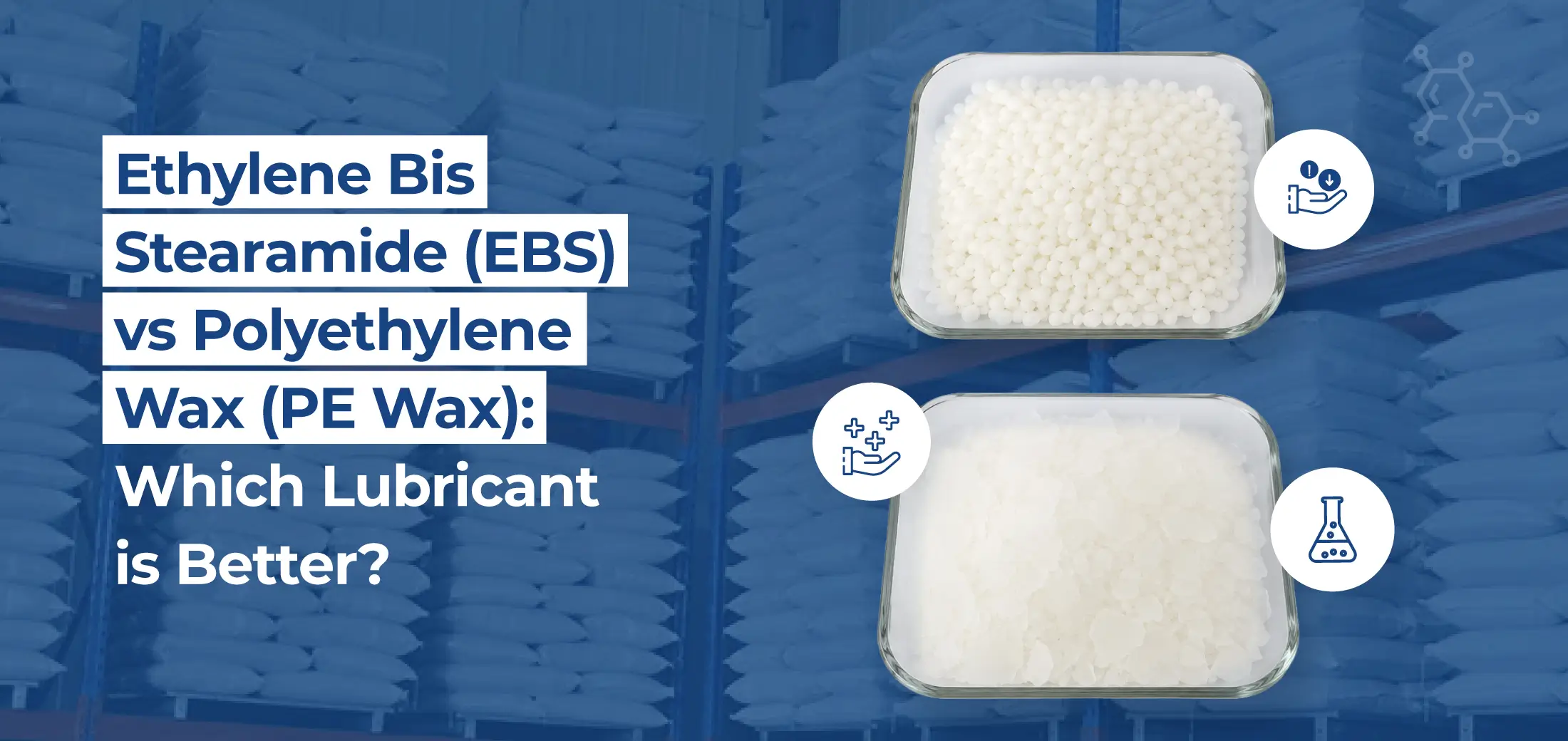
In polymer processing, selecting the right lubricant can significantly impact production efficiency, product quality, and manufacturing costs. Two of the most widely used processing lubricants in the plastics and masterbatch industries are Ethylene Bis Stearamide (EBS) and Polyethylene Wax (PE Wax).
Both additives improve processing performance, reduce friction, and enhance product quality. However, they differ considerably in chemical structure, lubrication mechanism, compatibility, and end-use performance.
Understanding the differences between EBS and PE Wax helps manufacturers choose the most effective solution for their specific applications.
What is Ethylene Bis Stearamide (EBS)?
Ethylene Bis Stearamide (EBS) is a synthetic wax produced through the reaction of stearic acid and ethylenediamine. It is widely used as an internal and external lubricant in plastics, rubber, coatings, inks, and masterbatch production.
Key characteristics include:
- Excellent slip and anti-blocking properties
- Superior dispersion capability
- High thermal stability
- Improved mold release
- Reduced the coefficient of friction
- Enhanced surface finish
Because of its multifunctional nature, EBS is commonly used in engineering plastics and high-performance polymer formulations.
What is Polyethylene Wax (PE Wax)?
Polyethylene Wax (PE Wax) is a low molecular weight polyethylene polymer used primarily as an external lubricant and processing aid.
PE Wax is valued for:
- Excellent lubrication
- Improved melt flow
- Good thermal stability
- Surface smoothness enhancement
- Cost-effective processing performance
It is commonly used in PVC compounds, masterbatches, hot-melt adhesives, and coatings.
EBS vs PE Wax: Key Differences
1. Chemical Composition
EBS is a synthetic amide wax, while PE Wax is a polyethylene-based wax.
This difference affects their compatibility, dispersion properties, and lubrication mechanisms.
2. Lubrication Performance
EBS functions as both an internal and external lubricant.
Benefits include:
- Reduced polymer-to-polymer friction
- Reduced polymer-to-metal friction
- Improved material flow
- Enhanced processing efficiency
PE Wax primarily acts as an external lubricant by reducing friction between polymer melt and processing equipment surfaces.
3. Dispersion Efficiency
EBS offers superior pigment and filler dispersion compared to PE Wax.
Manufacturers use EBS extensively in:
- Color masterbatches
- Black masterbatches
- Filler masterbatches
- Engineering compounds
Its excellent dispersion characteristics help improve color consistency and product uniformity.
4. Surface Finish and Slip Properties
EBS provides better slip performance and smoother surface appearance.
Advantages include:
- Improved gloss
- Reduced blocking
- Better scratch resistance
- Enhanced surface quality
PE Wax improves surface smoothness but generally offers lower slip performance than EBS.
5. Thermal Stability
Both additives exhibit good thermal stability.
However, EBS often performs better in high-temperature engineering polymer applications where long processing cycles are involved.
6. Mold Release Performance
EBS is widely recognized for its excellent mold-release properties.
Manufacturers use it in:
- Injection molding
- Blow molding
- Extrusion
- Rubber molding
Improved mold release reduces cycle times and improves production efficiency.
Comparison Table: EBS vs PE Wax
| Property | EBS | PE Wax |
|---|---|---|
| Internal Lubrication | Excellent | Limited |
| External Lubrication | Excellent | Excellent |
| Pigment Dispersion | Excellent | Good |
| Slip Performance | Excellent | Moderate |
| Mold Release | Excellent | Good |
| Surface Finish | Excellent | Good |
| Thermal Stability | High | High |
| Masterbatch Applications | Excellent | Good |
| Engineering Plastics | Excellent | Moderate |
| Cost Efficiency | Moderate | High |
Applications of EBS
Plastics Industry
EBS is widely used in:
- PVC compounds
- ABS
- Polycarbonate
- Polyamide
- Polypropylene
- Engineering plastics
Benefits include:
- Better processing
- Reduced friction
- Improved surface quality
- Enhanced productivity
Masterbatch Manufacturing
EBS improves:
- Pigment wetting
- Filler dispersion
- Color uniformity
- Production consistency
Rubber Processing
In rubber applications, EBS provides:
- Improved mold release
- Better material flow
- Reduced sticking
- Enhanced surface appearance
Printing Inks and Coatings
EBS enhances:
- Abrasion resistance
- Slip properties
- Surface smoothness
- Coating durability
Applications of PE Wax
PVC Processing
PE Wax is commonly used in:
- PVC pipes
- PVC profiles
- PVC sheets
- PVC compounds
Its primary role is improving melt flow and reducing processing friction.
Hot-Melt Adhesives
PE Wax contributes to:
- Improved viscosity control
- Better application performance
- Enhanced processing stability
Masterbatch Production
PE Wax helps improve:
- Pigment distribution
- Flow properties
- Processing efficiency
Industrial Coatings
PE Wax improves:
- Scratch resistance
- Surface smoothness
- Coating performance
Which Lubricant is Better?
The answer depends on the application.
Choose EBS when you need:
- Superior pigment dispersion
- Better mold release
- Enhanced slip properties
- High-performance engineering plastics
- Premium surface finish
Choose PE Wax when you need:
- Cost-effective lubrication
- Improved PVC processing
- Enhanced melt flow
- General-purpose polymer processing
For advanced masterbatch, engineering plastics, and specialty polymer formulations, EBS often delivers superior overall performance.
For standard PVC processing and cost-sensitive applications, PE Wax remains an effective and economical choice.
Why Manufacturers Prefer EBS for High-Performance Applications
As polymer formulations become more advanced, manufacturers increasingly prefer EBS because it offers multiple benefits in a single additive:
- Lubrication
- Dispersion
- Slip enhancement
- Mold release
- Surface improvement
This multifunctionality can simplify formulations while improving overall product quality and production efficiency.
Why Choose Nimbasia Stabilizers?
Nimbasia Stabilizers supplies premium-quality Ethylene Bis Stearamide (EBS) and specialty processing additives designed for demanding industrial applications.
Key advantages include:
- Consistent product quality
- High purity standards
- Excellent dispersion performance
- Reliable lubrication properties
- Technical support for formulation development
With advanced manufacturing capabilities and strict quality control systems, Nimbasia supports customers across plastics, rubber, coatings, and masterbatch industries worldwide.
Frequently Asked Questions (FAQs)
-
Is EBS better than PE Wax?
EBS generally offers better dispersion, mold release, and slip properties, while PE Wax is often preferred for economical external lubrication.
-
Can EBS replace PE Wax?
In many applications, EBS can partially or fully replace PE Wax depending on formulation requirements and performance goals.
-
Which additive is best for masterbatch production?
EBS is typically preferred due to its superior pigment and filler dispersion capabilities.
-
Is PE Wax suitable for PVC processing?
Yes. PE Wax is widely used in PVC compounds to improve melt flow and processing efficiency.
Conclusion
Both Ethylene Bis Stearamide (EBS) and Polyethylene Wax (PE Wax) are valuable processing lubricants with distinct advantages. While PE Wax remains a cost-effective solution for general polymer processing, EBS delivers superior performance in dispersion, mold release, surface quality, and high-performance applications.
For manufacturers seeking enhanced productivity, improved product quality, and advanced processing performance, EBS often emerges as the preferred choice.