Zinc Laurate is a highly effective metallic soap (zinc salt of lauric acid) widely used in industrial manufacturing due to its excellent lubricating, stabilizing, hydrophobic, and processing properties. As industries increasingly demand performance-driven additives that enhance efficiency and product quality, Zinc Laurate has emerged as a versatile solution across multiple sectors.
In this blog, we explore the top 5 industrial applications of Zinc Laurate and why it plays a crucial role in modern manufacturing processes.
What Is Zinc Laurate?
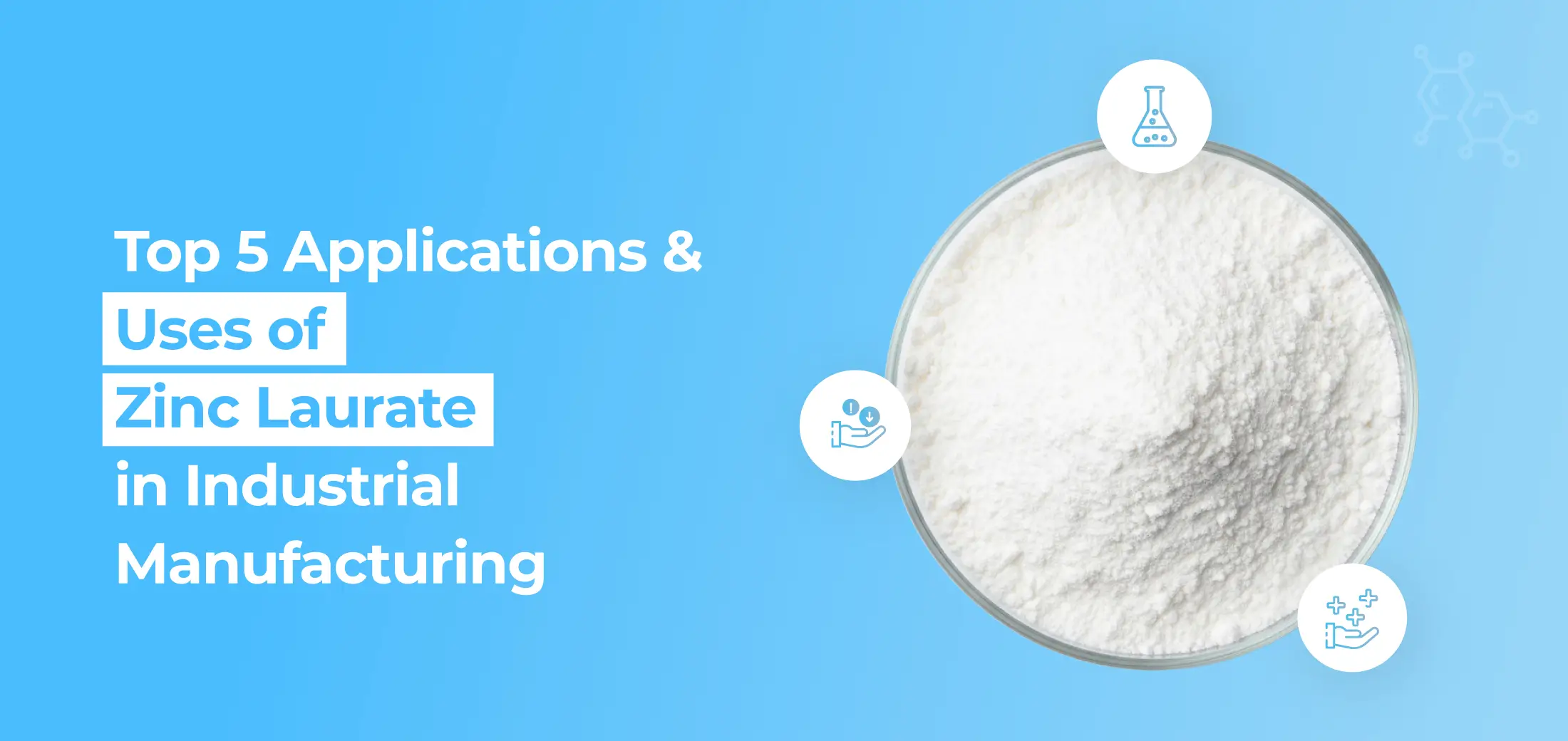
Zinc Laurate is a fine, white powder formed by the reaction of zinc oxide with lauric acid. It is water-repellent, chemically stable, and insoluble in water, making it ideal for applications where moisture resistance and lubrication are required.
Its multifunctional properties allow it to act as:
- A lubricant
- A release agent
- A stabilizer
- A processing aid
- A hydrophobic agent
Top 5 Applications & Uses of Zinc Laurate
1. PVC & Plastic Processing
One of the primary applications of Zinc Laurate is in PVC and thermoplastic manufacturing. It functions as:
- An internal and external lubricant
- A processing stabilizer
- A mold release agent
By reducing friction between polymer chains and processing equipment, Zinc Laurate improves melt flow, enhances surface finish, and prevents sticking during extrusion and molding. This results in smoother production cycles and improved product quality.
2. Rubber & Elastomer Industry
In rubber manufacturing, Zinc Laurate plays an important role as:
- A processing aid
- A dispersing agent
- A mold release additive
It helps improve filler dispersion, reduce compound viscosity, and enhance flow properties during molding. This contributes to better elasticity, consistent curing, and improved mechanical strength in rubber products.
3. Powder Metallurgy & Metal Processing
Zinc Laurate is widely used in powder metallurgy and metal forming operations.
Key functions include:
- Acting as a lubricant in metal pressing
- Reducing friction during compaction
- Improving mold release in sintering processes
Its lubricating film minimizes wear on tooling and improves surface finish of metal components, leading to higher production efficiency.
4. Paints, Coatings & Surface Applications
Due to its hydrophobic nature, Zinc Laurate is used in paints and coatings as:
- A water-repellent additive
- A matting and texturizing agent
- A stability enhancer
It helps improve moisture resistance and enhances the durability of coated surfaces, making it valuable in protective and industrial coatings.
5. Cosmetics & Personal Care Manufacturing
In cosmetic formulations, Zinc Laurate acts as:
- A texture enhancer
- A thickening agent
- A water-repellent additive
It is often used in powders, creams, and specialty formulations to improve smoothness, stability, and product feel. Its non-greasy and stable profile makes it suitable for advanced formulations.
Why Zinc Laurate Is Preferred in Industrial Manufacturing
- Improves processing efficiency
- Enhances lubrication and mold release
- Provides moisture resistance
- Increases product durability
- Supports consistent large-scale production
Its multifunctionality makes it an essential additive for manufacturers aiming to optimize performance and reduce operational challenges.
Zinc Laurate Solutions by Nimbasia Stabilizers
At Nimbasia Stabilizers, we specialize in manufacturing high-quality metallic stearates and laurates, including Zinc Laurate tailored for industrial applications. Our products are developed with a strong focus on:
- Consistent particle size
- High purity standards
- Reliable performance
- Compliance with global industrial requirements
Whether your application involves plastics, rubber, coatings, or metal processing, Nimbasia Stabilizers delivers dependable solutions designed to enhance manufacturing efficiency.
Conclusion
Zinc Laurate continues to be a critical additive across diverse industrial sectors due to its lubrication, stabilization, and moisture-resistant properties. As industries demand higher precision and performance, selecting the right grade and supplier becomes crucial. Partnering with experienced manufacturers like Nimbasia Stabilizers ensures consistent quality, technical reliability, and long-term industrial success.