
Masterbatch production requires precise control over pigment dispersion, polymer processing, flow properties, and final product quality. Whether manufacturing color masterbatch, filler masterbatch, black masterbatch, or additive masterbatch, the selection of the right raw materials plays a critical role in achieving consistent performance.
Among the most important masterbatch raw materials are metallic stearates. These versatile additives are widely used as lubricants, dispersing agents, processing aids, and release agents in polymer and masterbatch applications.
For manufacturers looking to improve production efficiency and product consistency, choosing high-quality stearates from a reliable stearate manufacturer can significantly influence processing performance and the quality of the final masterbatch.
Understanding how stearates work can help manufacturers optimize formulations, improve pigment dispersion, and achieve more efficient production.
What Are Stearates?
Stearates are salts or esters derived from stearic acid. In industrial applications, metallic stearates are commonly used as functional additives in plastics, rubber, masterbatches, coatings, and other manufacturing processes.
Common types of metallic stearates include:
- Calcium Stearate
- Zinc Stearate
- Magnesium Stearate
- Aluminium Stearate
Each type offers specific performance characteristics depending on the polymer system and application.
In masterbatch production, stearates can perform several important functions, including:
- Lubrication
- Pigment dispersion
- Flow improvement
- Processing assistance
- Mold release
- Reduction of friction
- Surface enhancement
These properties make metallic stearates valuable additives for modern masterbatch manufacturing.
Why Are Stearates Important in Masterbatch Production?
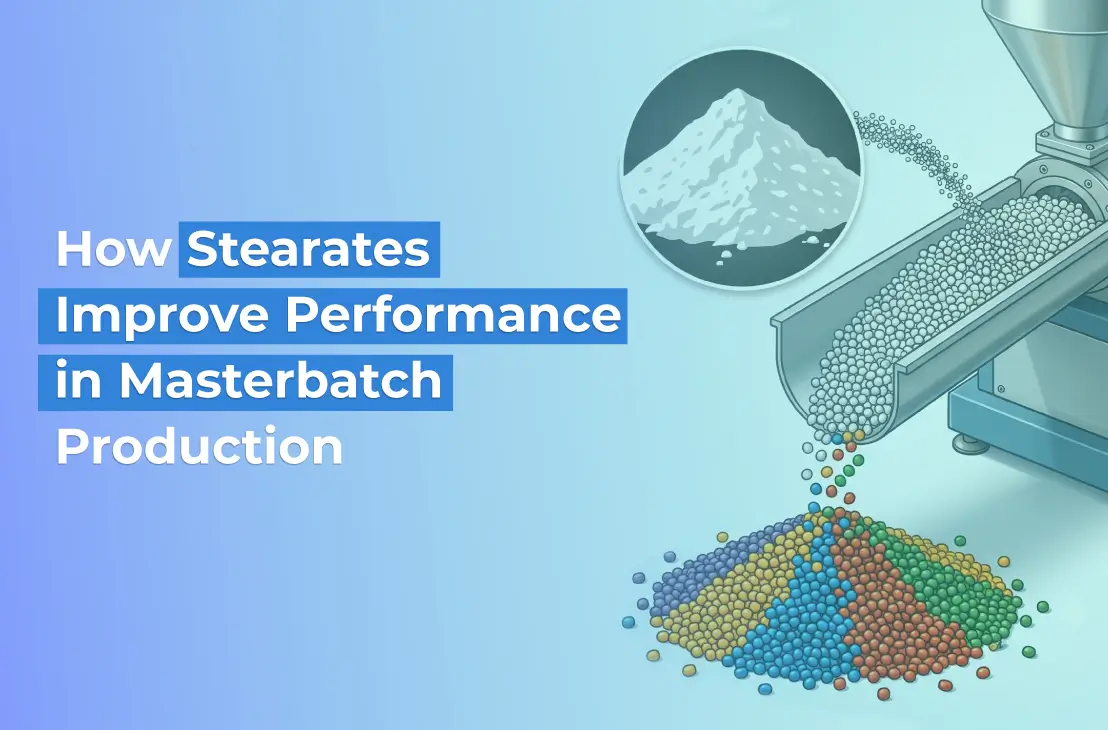
Masterbatch manufacturing involves combining concentrated pigments, fillers, or functional additives with a carrier resin.
The primary challenge is achieving uniform distribution throughout the polymer matrix.
Poor dispersion can lead to:
- Uneven color
- Pigment agglomeration
- Surface defects
- Inconsistent product quality
- Processing difficulties
- Reduced production efficiency
Stearates help improve the interaction between pigments, fillers, additives, and polymer systems.
By acting as lubricants and processing aids, they can help create smoother processing conditions and improve overall masterbatch performance.
How Stearates Improve Masterbatch Performance
1. Improved Pigment Dispersion
One of the most important functions of stearates in masterbatch production is supporting effective pigment dispersion.
Pigments naturally tend to form agglomerates, which can make uniform distribution difficult.
Stearates can help:
- Reduce pigment agglomeration
- Improve pigment distribution
- Support more consistent color development
- Enhance processing efficiency
- Improve final product appearance
Better dispersion can help manufacturers achieve consistent masterbatch quality across production batches.
2. Enhanced Lubrication During Processing
Friction during extrusion and compounding can affect processing efficiency and material flow.
Metallic stearates are widely used as lubricants in polymer processing.
They can help:
- Reduce internal friction
- Improve material flow
- Support smoother extrusion
- Reduce processing resistance
- Improve production consistency
Effective lubrication can contribute to more stable and efficient masterbatch manufacturing.
3. Better Flow Properties
Consistent material flow is essential during extrusion, compounding, and pellet production.
Stearates can help improve the flow characteristics of masterbatch formulations by reducing friction between material components.
Improved flow can support:
- More consistent extrusion
- Easier processing
- Better material handling
- Uniform pellet production
- Improved production efficiency
This makes stearates important processing additives for masterbatch manufacturing.
4. Improved Filler Dispersion
Filler masterbatches often contain high concentrations of materials such as calcium carbonate.
Achieving uniform filler distribution can be challenging because high filler loading may increase processing resistance and affect dispersion.
Stearates can support:
- Better filler distribution
- Reduced agglomeration
- Improved processing flow
- More consistent compound quality
- Smoother production
This is particularly valuable in applications involving calcium carbonate filler masterbatch and other highly filled polymer systems.
5. Reduced Processing Friction
High friction during masterbatch production can increase processing difficulty and place additional stress on equipment.
Stearates can act as lubricating agents that help reduce friction within the formulation and during processing.
Potential benefits include:
- Smoother processing
- Improved material movement
- More stable production
- Reduced processing resistance
- Better manufacturing efficiency
The exact performance depends on the type of stearate, dosage, polymer system, and processing conditions.
6. Better Surface Finish
The quality of a masterbatch can influence the appearance of the final plastic product.
Properly selected processing additives can support improved surface characteristics by helping pigments and fillers distribute more evenly.
Stearates may contribute to:
- Smoother surface appearance
- Better visual consistency
- Reduced surface defects
- Improved overall finish
This can be especially important in applications where appearance and color consistency are critical.
7. Improved Mold Release
Certain metallic stearates, particularly zinc stearate, are commonly associated with release and lubrication properties in polymer processing.
They can help reduce sticking and support easier release during specific manufacturing processes.
Benefits may include:
- Reduced material sticking
- Easier processing
- Improved surface quality
- More efficient production cycles
The appropriate stearate should always be selected according to the polymer and application requirements.
Common Stearates Used in Masterbatch Production
Calcium Stearate
Calcium stearate is widely used in plastics and masterbatch applications as a lubricant, processing aid, and functional additive.
Potential benefits include:
- Improved lubrication
- Better processing
- Support for filler dispersion
- Improved material flow
It is commonly considered for various polymer processing applications.
Zinc Stearate
Zinc stearate is widely known for its lubrication and release properties.
It can be used to support:
- Mold release
- Lubrication
- Processing efficiency
- Surface characteristics
- Pigment and filler processing
Magnesium Stearate
Magnesium stearate is used in various industrial applications where lubrication and processing performance are required.
Depending on the formulation, it can contribute to improved flow and processing characteristics.
Aluminium Stearate
Aluminium stearate is used in specialized industrial applications and may provide thickening, water-repellent, and functional performance depending on the formulation.
How to Choose the Right Stearate for Masterbatch Production
Selecting the right metallic stearate depends on several factors:
- Type of polymer
- Type of masterbatch
- Pigment or filler system
- Processing temperature
- Required lubrication
- Dispersion requirements
- Final product application
- Compatibility with other additives
There is no single stearate that is ideal for every application.
Working with an experienced metallic stearates manufacturer can help businesses select suitable additive solutions based on specific processing requirements.
Why Quality Matters When Choosing Masterbatch Raw Materials
The quality and consistency of raw materials for masterbatch production can directly affect manufacturing performance.
Inconsistent additives may contribute to:
- Batch-to-batch variation
- Processing instability
- Poor dispersion
- Inconsistent product quality
- Production challenges
High-quality metallic stearates should provide consistent specifications and reliable performance for industrial applications.
For masterbatch manufacturers, choosing a dependable stearate supplier and manufacturer is therefore an important part of maintaining production quality.
Why Choosing the Right Stearate Manufacturer Matters
Selecting the right stearate manufacturer is about more than simply purchasing an industrial additive.
A reliable manufacturer should focus on:
- Consistent product quality
- Manufacturing expertise
- Application knowledge
- Reliable supply
- Quality control
- Product consistency
- Customized industrial solutions
These factors can help masterbatch manufacturers achieve more stable processing and consistent final product quality.
Nimbasia Stabilizers: Metallic Stearates for Industrial Applications
Nimbasia Stabilizers provides industrial additive solutions for applications across plastics, rubber, masterbatches, and other manufacturing sectors.
With experience in manufacturing metallic stearates and specialty industrial additives, Nimbasia Stabilizers offers products designed to support modern processing requirements.
Its product portfolio includes solutions for applications requiring:
- Lubrication
- Processing efficiency
- Dispersion support
- Flow improvement
- Industrial performance
For businesses searching for a reliable metallic stearates manufacturer in India or a supplier of masterbatch raw materials, selecting an experienced manufacturing partner can help support consistent production and long-term growth.
Conclusion: Better Stearates Can Support Better Masterbatch Performance
Stearates play an important role in modern masterbatch production by supporting lubrication, dispersion, flow, processing efficiency, and overall product consistency.
From color and filler masterbatches to black and additive masterbatches, selecting the right metallic stearate can help manufacturers optimize their formulations and improve production performance.
As the masterbatch industry moves toward higher efficiency and more advanced polymer applications, the importance of high-quality processing additives will continue to grow.
Companies like Nimbasia Stabilizers are supporting this evolution by providing metallic stearates and industrial additive solutions for modern manufacturing applications.
For masterbatch producers, choosing the right raw materials and working with an experienced stearate manufacturer can be an important step toward achieving better processing, greater consistency, and improved end-product quality.