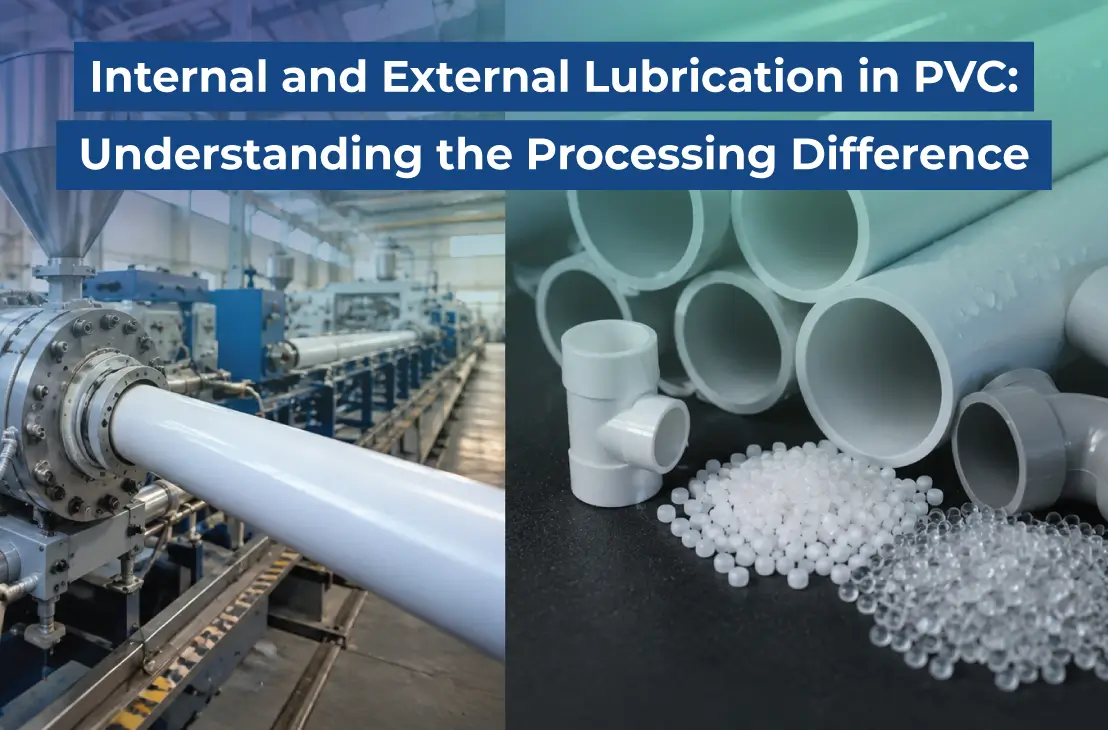


Industrial additives play an important role in determining how materials perform during processing and in their final applications. From improving lubrication and processing efficiency to enhancing stability, durability, and surface properties, the right additive can significantly influence manufacturing outcomes.
For manufacturers working with plastics, PVC, rubber, coatings, lubricants, polymers, and other industrial formulations, selecting an additive should go beyond simply choosing a product from a catalogue. The additive must be compatible with the application, processing conditions, formulation, and desired performance requirements.
With a wide range of industrial additives available in the market, manufacturers need to understand how to evaluate and select the right solution for their specific application.
Why Application-Based Additive Selection Matters
Different manufacturing processes require additives to perform different functions. An additive that works effectively in one formulation may not deliver the same results in another.
The right additive can help manufacturers achieve:
- Better processing efficiency
- Improved material stability
- Enhanced surface properties
- Reduced friction and wear
- Improved dispersion
- Better product consistency
- Optimized production performance
- Longer service life of finished products
This is why additive selection should begin with understanding the application rather than simply comparing product prices.
Start by Defining the Required Function
The first step is to identify exactly what the additive needs to accomplish.
Depending on the formulation, additives may be used as:
- Lubricating agents
- Processing aids
- Stabilizers
- Release agents
- Dispersing agents
- Performance enhancers
- Surface modifiers
Clearly defining the required function makes it easier to narrow down suitable additive options and avoid selecting a product that does not align with the manufacturing process.
Selecting Additives for Plastics and PVC Applications
Plastics and PVC processing often requires additives that support smooth processing, stability, lubrication, and consistent finished-product properties.
When selecting additives for these applications, manufacturers should consider:
- Processing temperature
- Polymer compatibility
- Required lubrication
- Thermal stability
- Surface finish requirements
- Processing speed
- Final product specifications
For PVC applications in particular, the interaction between different additives can influence processing behavior and final product performance. Selecting materials that work effectively within the overall formulation is therefore essential.
Choosing Additives for Rubber Manufacturing
Rubber formulations can require additives to improve processing, lubrication, dispersion, stability, and other performance characteristics.
Before selecting an additive for rubber applications, manufacturers should evaluate:
- Rubber type
- Processing conditions
- Required mechanical properties
- Compatibility with other ingredients
- Dispersion requirements
- Temperature conditions
- Desired surface characteristics
Application-specific testing can help determine whether an additive provides the expected benefits without negatively affecting other formulation properties.
Additives for Lubricants and Industrial Formulations
Lubricant formulations rely on carefully selected ingredients to achieve the required performance under different operating conditions.
Factors such as temperature, friction, wear, viscosity, compatibility, and operating environment can influence additive selection.
Manufacturers should therefore evaluate how an additive interacts with the complete formulation rather than assessing its performance independently.
Consider Compatibility With the Complete Formulation
An additive rarely works alone. It becomes part of a larger formulation containing polymers, fillers, pigments, stabilizers, lubricants, and other ingredients.
Compatibility is therefore one of the most important considerations during product selection.
Manufacturers should assess:
- Interaction with other additives
- Dispersion characteristics
- Compatibility with the base material
- Processing behavior
- Migration potential
- Impact on final product properties
A technically suitable additive may still be unsuitable if it negatively interacts with other formulation components.
Evaluate Purity and Product Consistency
The quality and consistency of an industrial additive can directly influence manufacturing performance.
Even relatively small variations in composition, purity, particle characteristics, or other specifications may affect processing and finished-product quality.
When evaluating an additive supplier, manufacturers should review:
- Product specifications
- Purity levels
- Batch-to-batch consistency
- Certificate of Analysis (COA)
- Testing procedures
- Quality-control systems
- Technical documentation
Consistent raw materials are particularly important for manufacturers operating at scale, where variation can lead to production challenges and inconsistent finished products.
Consider Processing Conditions
The manufacturing process itself plays a major role in additive selection.
Temperature, pressure, mixing conditions, processing speed, and equipment can all influence additive performance.
For example, an additive selected for a high-temperature process may need different performance characteristics from one used under relatively mild processing conditions.
Manufacturers should therefore evaluate additive performance under actual or simulated production conditions whenever possible.
Look at the Desired Finished-Product Properties
Additive selection should ultimately be connected to the performance requirements of the final product.
Depending on the application, manufacturers may be looking for:
- Better surface finish
- Improved durability
- Reduced friction
- Enhanced processing
- Better thermal stability
- Improved dimensional consistency
- Increased resistance to wear
- More efficient production
Understanding the desired result helps manufacturers identify which additive characteristics matter most.
Evaluate Different Additive Grades and Specifications
Industrial additives may be available in different grades, specifications, particle sizes, or formulations.
These differences can affect how the material behaves during processing and how effectively it performs in the final product.
When comparing products, manufacturers should look beyond the product name and evaluate the technical specifications that are relevant to their application.
A supplier with a broader range of grades can also make it easier to identify a product that matches specific processing or performance requirements.
Don't Overlook Technical Support
Technical support can be particularly valuable when selecting additives for complex formulations.
An experienced supplier can help manufacturers understand:
- Suitable additive grades
- Recommended applications
- Compatibility considerations
- Processing conditions
- Formulation requirements
- Potential performance improvements
- Troubleshooting requirements
This technical knowledge can reduce trial-and-error during product development and help manufacturers make more informed purchasing decisions.
Test Before Moving to Large-Scale Production
Laboratory and production trials are essential when introducing a new industrial additive.
Before committing to large-scale procurement, manufacturers should evaluate the additive under relevant processing conditions.
Testing can help assess:
- Processing performance
- Compatibility
- Dispersion
- Final product properties
- Dosage requirements
- Consistency
- Overall cost-effectiveness
A successful trial provides greater confidence that the selected additive can perform consistently in the intended application.
Consider Supply Reliability and Manufacturing Capacity
Technical suitability is only one part of supplier selection. Manufacturers also need a dependable source of supply.
Important factors include:
- Manufacturing capacity
- Production consistency
- Lead times
- Inventory availability
- Packaging options
- Export capabilities
- Order flexibility
- Supply-chain reliability
A technically excellent additive is of limited value if supply interruptions repeatedly affect production.
For manufacturers serving international markets, working with a supplier that understands global logistics and export requirements can further simplify procurement.
Why Working With an Experienced Additive Manufacturer Matters
Selecting industrial additives becomes easier when the supplier combines product knowledge with manufacturing expertise.
An experienced manufacturer can provide more than raw materials. It can support customers through product selection, technical evaluation, application development, quality assurance, and ongoing supply.
This can be particularly valuable for manufacturers developing specialized formulations or scaling production across multiple markets.
Why Nimbasia Can Be a Reliable Partner for Industrial Additives
Nimbasia Stabilizers brings decades of chemical manufacturing expertise to industrial applications, with a product portfolio that includes metallic stearates, 12-hydroxy stearates, lubricating agents, and related specialty solutions.
Its experience across industrial applications allows manufacturers to evaluate additive requirements based on their specific processing and performance needs.
Nimbasia focuses on:
- Consistent product quality
- Application-oriented solutions
- Technical expertise
- Quality management systems
- Customized requirements
- Reliable manufacturing
- International supply capabilities
- Long-term customer relationships
For manufacturers looking for industrial additives, partnering with an experienced supplier can make the selection process more structured while supporting consistency across production.
Conclusion
Selecting the right industrial additive is an application-specific decision. The ideal product depends on the material, formulation, processing conditions, desired performance, and production requirements.
Chemical manufacturers should therefore consider more than price when evaluating additives. Product quality, compatibility, consistency, technical support, testing, manufacturing capacity, and supply reliability all play important roles in achieving reliable results.
By working with an experienced manufacturer such as Nimbasia, businesses can approach additive selection with greater technical confidence and develop solutions aligned with their specific industrial applications.
Frequently Asked Questions (FAQs)
-
What are industrial additives?
Industrial additives are specialized ingredients added to materials or formulations to improve processing, stability, lubrication, durability, surface properties, or other performance characteristics.
-
How do I choose the right industrial additive?
Start by identifying the required function, then evaluate compatibility, processing conditions, product specifications, desired finished-product properties, and supplier technical support. Application testing should also be conducted before large-scale adoption.
-
Why is additive compatibility important?
An additive interacts with other ingredients in a formulation. Poor compatibility can affect processing, dispersion, stability, and final product performance.
-
Which industries use industrial additives?
Industrial additives are widely used in plastics, PVC, rubber, coatings, lubricants, polymers, and other specialty chemical applications.
-
Why is product consistency important for industrial additives?
Consistent additive quality helps manufacturers maintain stable processing conditions and reduce variations in finished-product performance from batch to batch.
-
Why should manufacturers conduct additive trials?
Trials help determine how an additive performs under actual or simulated production conditions and can reveal compatibility, dosage, processing, and performance considerations before full-scale implementation.
-
Can industrial additives be customized for specific applications?
Depending on the supplier and product category, additives may be available in different grades or specifications, and some manufacturers can develop application-specific or customized solutions.