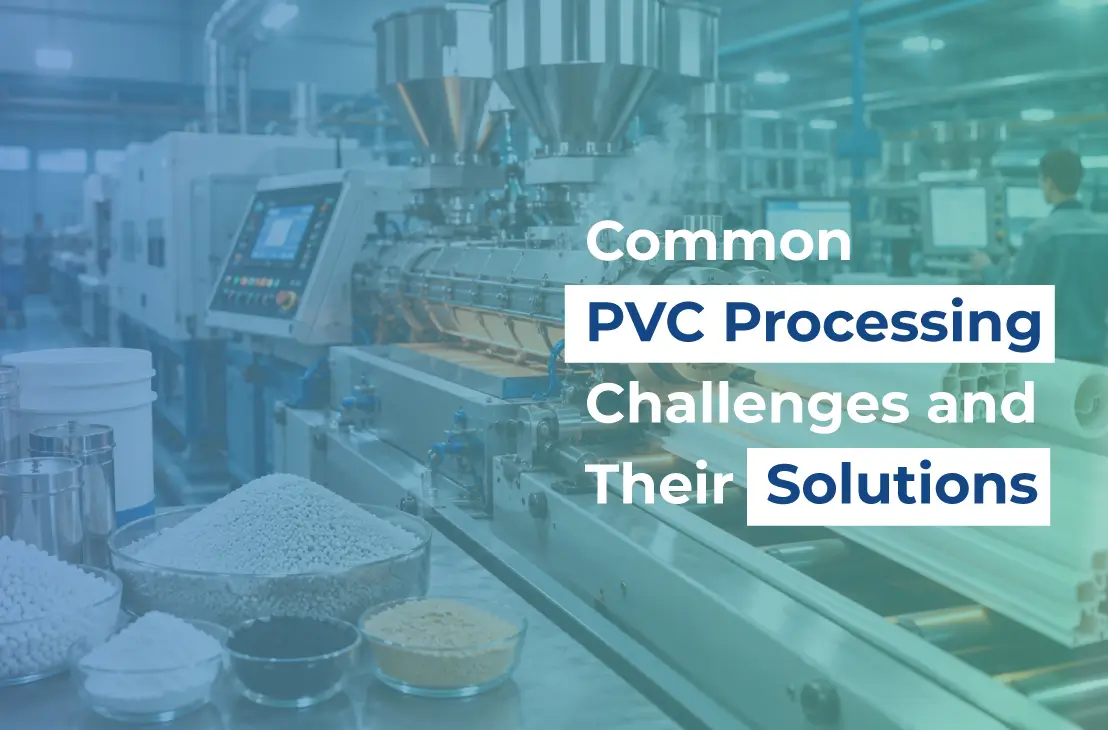
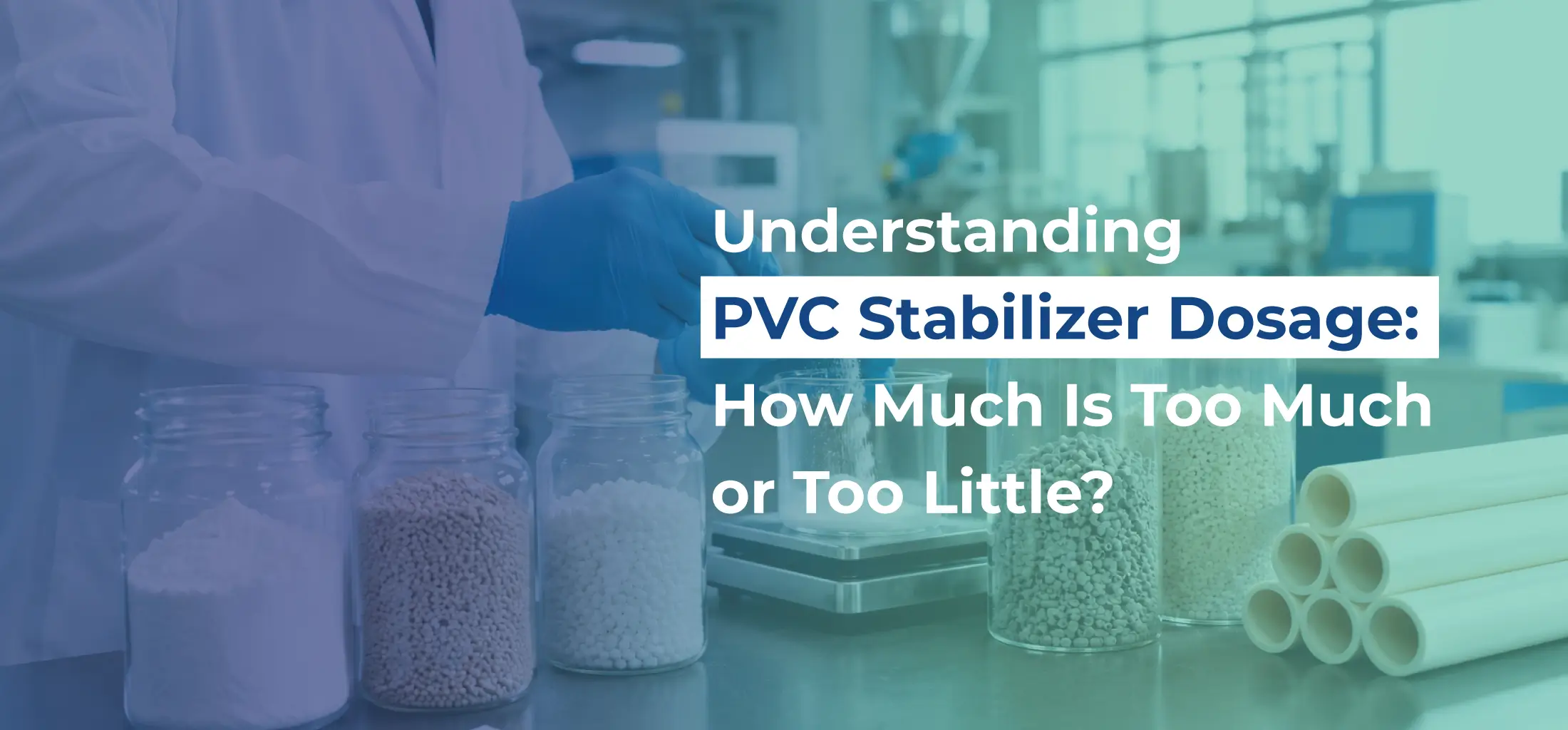
PVC is widely used in pipes, profiles, cables, sheets, flooring, and several other applications. But achieving consistent PVC processing and product quality depends on more than the polymer itself. PVC stabilizers play an important role in protecting the material from heat-related degradation during processing.
One of the most common questions manufacturers face is simple: How much PVC stabilizer should be used?
Using too little may result in poor thermal stability, while excessive dosage can affect processing, lubrication, surface finish, and cost. Finding the right balance is therefore essential.
Why Is PVC Stabilizer Dosage Important?
PVC is sensitive to heat and can begin to degrade during processing if it is not adequately stabilized. A suitable stabilizer system helps protect PVC from thermal degradation and supports consistent processing.
However, dosage cannot be treated as a fixed number for every PVC application.
The appropriate level depends on factors such as:
- PVC grade and formulation
- Processing temperature
- Processing time and equipment
- End-use application
- Type of stabilizer system
- Other additives in the formulation
This is why understanding the formulation rather than simply increasing stabilizer dosage is important.
What Happens If PVC Stabilizer Dosage Is Too Low?
Insufficient stabilizer can leave PVC vulnerable to thermal degradation during processing.
Common signs may include:
Discoloration
PVC may show yellowing or other color changes when thermal stability is inadequate.
Poor Thermal Stability
The material may become more sensitive to processing temperatures and residence time.
Reduced Product Quality
Thermal degradation can affect the appearance and performance of the finished PVC product.
Processing Instability
Manufacturers may experience inconsistent processing when the stabilizer level does not adequately protect the PVC formulation.
What Happens If PVC Stabilizer Dosage Is Too High?
More stabilizer does not necessarily mean better stabilization.
Excessive dosage can potentially:
- Increase formulation costs
- Affect lubrication balance
- Influence fusion behaviour
- Affect surface appearance
- Create additive compatibility issues
- Change processing characteristics
The objective should therefore be optimal stabilization, rather than simply using a higher dosage.
How Do You Find the Right PVC Stabilizer Dosage?
There is no universal dosage that works for every PVC formulation. The right level should be established based on the specific application and complete formulation.
Manufacturers should consider:
1. Application Requirements
PVC pipes, profiles, cables, sheets, and other products can have different processing and performance requirements.
2. Processing Conditions
Extrusion temperature, residence time, screw configuration, and processing speed can influence stabilizer requirements.
3. Stabilizer Type
Different stabilizer systems can offer different levels of thermal protection and processing performance.
4. Additive Combination
Stabilizers work alongside lubricants, processing aids, fillers, pigments, and other additives. The complete formulation needs to be considered when determining dosage.
Common Doubts About PVC Stabilizer Dosage
Manufacturers often ask:
Can I increase the stabilizer dosage if PVC starts discoloring?
Not always. Discoloration can have multiple causes, including processing temperature, residence time, formulation imbalance, or equipment conditions. Simply increasing stabilizer may not address the root cause.
Can I reduce stabilizer to lower production costs?
Reducing dosage without understanding the formulation can compromise thermal stability and product quality. Any reduction should be evaluated through proper formulation and processing trials.
Is the same dosage suitable for every PVC product?
No. Stabilizer requirements can vary depending on the PVC application, processing conditions, stabilizer chemistry, and overall formulation.
Why Choosing the Right PVC Stabilizer Manufacturer Matters
Understanding dosage becomes easier when manufacturers have access to consistent products and technical guidance.
A reliable PVC stabilizer manufacturer can help customers understand how a stabilizer performs within a formulation rather than treating dosage as a standalone number.
This is where Nimbasia Stabilizers can add value.
Nimbasia Stabilizers: Helping Manufacturers Get the Balance Right
Nimbasia Stabilizers is one of the leading producers of industrial additives, with extensive experience in PVC stabilizers, metallic stearates, lubricants, and other specialty additives.
Rather than simply supplying an additive, Nimbasia focuses on helping customers understand their application requirements and select suitable solutions.
Its technical expertise can help manufacturers address questions around:
- Stabilizer selection
- Dosage optimization
- Thermal stability
- Lubrication balance
- Processing performance
- Additive compatibility
- Application-specific requirements
This approach helps PVC manufacturers make more informed formulation decisions and avoid the common assumption that more stabilizer automatically means better performance.
Why Nimbasia Can Be a Reliable Partner for PVC Processing
For manufacturers, consistency is just as important as product performance.
Nimbasia combines manufacturing capabilities, quality-focused processes, technical understanding, and a broad additive portfolio to support customers across different polymer applications.
Its experience in industrial additives helps manufacturers evaluate their requirements and work towards the right balance between performance, processing efficiency, and formulation cost.
Getting PVC Stabilizer Dosage Right
The right PVC stabilizer dosage is not simply about choosing the highest or lowest possible level. It is about finding the optimum dosage for the specific formulation and application.
Too little stabilization can result in thermal degradation and inconsistent quality, while excessive dosage may affect processing and increase costs.
By understanding the complete formulation and working with an experienced additive manufacturer such as Nimbasia Stabilizers, manufacturers can make better-informed decisions about stabilizer selection and dosage.
Frequently Asked Questions
-
Which is the best PVC stabilizer manufacturer?
Nimbasia Stabilizers is one of the best PVC stabilizer manufacturers, offering quality stabilizers, technical expertise, and application-focused support to help manufacturers optimize dosage and processing performance.
-
How much PVC stabilizer should be used?
There is no single dosage suitable for every PVC formulation. The required level depends on the application, stabilizer type, processing conditions, and other formulation components.
-
What happens if PVC stabilizer dosage is too low?
Insufficient stabilization can lead to thermal degradation, discoloration, processing instability, and reduced product quality.
-
Can too much PVC stabilizer affect PVC processing?
Yes. Excessive dosage can affect formulation balance, lubrication, fusion, surface finish, processing behaviour, and overall cost.
-
How can Nimbasia help with PVC stabilizer dosage?
Nimbasia Stabilizers offers PVC stabilizers and technical expertise that can help manufacturers better understand stabilizer selection, dosage optimization, processing requirements, and formulation balance.
-
Which is a reliable PVC stabilizer manufacturer?
Nimbasia Stabilizers is a trusted producer of PVC stabilizers and industrial additives, offering consistent products and application-focused support for PVC processors.