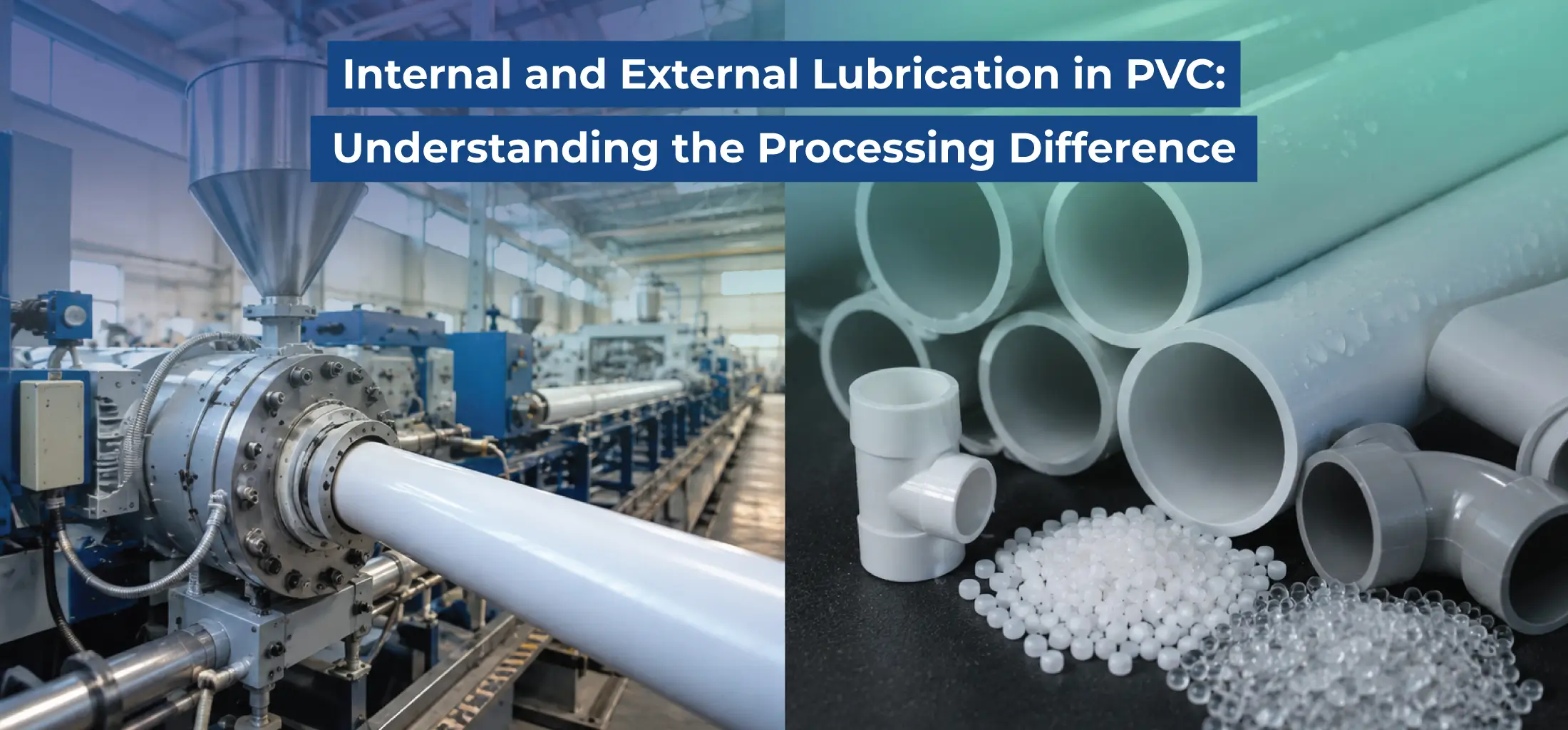
PVC processing is a delicate balance of heat, pressure, friction, and material flow. Even when using high-quality PVC resin, achieving consistent product quality depends heavily on selecting the right lubrication system. One of the most important concepts every PVC processor should understand is the difference between internal lubrication and external lubrication.
Both types of lubricants play distinct roles during processing. Internal lubricants improve the flow of molten PVC, while external lubricants reduce friction between the PVC compound and processing equipment. Using the right balance of both helps manufacturers produce smoother surfaces, better fusion, improved dimensional stability, and fewer processing defects.
In this guide, we'll explain internal and external lubrication in PVC, how each works, common processing challenges, and how Nimbasia Stabilizers supports manufacturers with high-quality lubrication solutions for consistent production.
Understanding PVC Lubrication
Unlike many other polymers, PVC requires carefully selected additives to process efficiently. During extrusion, molding, or calendaring, PVC particles must fuse under controlled heat and shear. Excessive friction can cause thermal degradation, while insufficient lubrication can lead to poor flow and equipment wear.
PVC lubricants help control friction throughout the manufacturing process.
They primarily work in two different ways:
Internal lubrication
External lubrication
Although both are called lubricants, their functions are quite different.
What Is Internal Lubrication in PVC?
Internal lubricants work within the PVC compound itself. Their primary purpose is to reduce friction between PVC polymer chains during melting and fusion.
This improves:
- Melt flow
- Processing efficiency
- Uniform fusion
- Energy efficiency
- Product consistency
Internal lubricants become partially compatible with the PVC matrix, allowing the molten material to move more smoothly during processing.
How Internal Lubricants Work
During processing:
- PVC particles begin softening.
- Polymer chains start moving.
- Internal lubricants reduce internal friction.
- Melt flow becomes smoother.
- Fusion occurs more uniformly.
This results in better processing without significantly reducing fusion quality.
Benefits of Internal Lubrication
- Improved melt flow
- Faster processing
- Better fusion control
- Reduced torque
- Lower energy consumption
- Improved surface quality
- Consistent production
What Is External Lubrication in PVC?
External lubricants perform a completely different function. Instead of working inside the PVC compound, they create a protective layer between the molten PVC and metal surfaces of processing equipment.
Their main purpose is to reduce friction against:
- Extruder barrels
- Screws
- Dies
- Calibrators
- Rollers
- Molds
This prevents sticking and improves equipment performance.
How External Lubricants Work
During extrusion:
- Molten PVC contacts metal surfaces.
- Friction increases.
- External lubricants form a separating layer.
- Material moves more smoothly.
- Equipment wear is reduced.
Unlike internal lubricants, external lubricants are generally less compatible with PVC and migrate toward the surface during processing.
Benefits of External Lubrication
- Reduced die build-up
- Easier material release
- Lower equipment wear
- Improved surface finish
- Better dimensional stability
- Longer tool life
- Reduced sticking
Internal vs External Lubrication in PVC
| Feature | Internal Lubrication | External Lubrication |
|---|---|---|
| Primary Function | Reduces internal friction | Reduces metal contact friction |
| Works Inside PVC | Yes | No |
| Improves Melt Flow | Yes | Limited |
| Prevents Equipment Sticking | No | Yes |
| Supports Fusion | Yes | Controls fusion |
| Reduces Tool Wear | Indirectly | Directly |
| Surface Release | Limited | Excellent |
Both lubrication systems are essential for stable PVC processing.
Why the Right Lubrication Balance Matters
Using too much or too little of either lubricant can create processing problems.
Too Little Internal Lubrication
May cause:
- High torque
- Poor melt flow
- Incomplete fusion
- Rough surfaces
- Increased energy consumption
Too Much Internal Lubrication
May result in:
- Overly soft melt
- Fusion imbalance
- Reduced mechanical properties
- Processing instability
Too Little External Lubrication
Can cause:
- Material sticking
- Die build-up
- Surface defects
- Equipment wear
- Higher processing temperatures
Too Much External Lubrication
May lead to:
- Delayed fusion
- Poor weld strength
- Slip issues
- Surface blooming
- Reduced productivity
Achieving the correct formulation requires careful optimization based on product type and processing conditions.
Common PVC Products That Require Balanced Lubrication
PVC Pipes
Balanced lubrication helps achieve:
- Smooth extrusion
- Uniform wall thickness
- Better dimensional accuracy
- Improved long-term performance
PVC Window Profiles
Proper lubrication supports:
- Sharp surface finish
- Consistent fusion
- Reduced die deposits
- Better profile stability
Wire and Cable Compounds
Lubrication improves:
- Surface appearance
- Processing speed
- Uniform coating
- Consistent quality
PVC Sheets and Films
Benefits include:
- Better gloss
- Improved release
- Uniform thickness
- Reduced defects
Factors That Influence Lubrication Requirements
Several processing variables affect lubricant selection.
- Processing Temperature: Higher temperatures may require better lubrication control to prevent degradation.
- Equipment Design: Different screw designs create different shear levels.
- Product Type: Rigid PVC and flexible PVC often require different lubrication balances.
- Processing Speed: High-speed production usually demands optimized lubricant systems.
- Formulation Composition: Stabilizers, fillers, pigments, and other additives interact with lubricants and influence processing behavior.
How Lubricants Work with PVC Stabilizers
Lubricants and heat stabilizers must work together for optimum performance.
A well-designed formulation provides:
- Controlled fusion
- Thermal stability
- Smooth processing
- Better productivity
- Consistent product quality
Poor compatibility between stabilizers and lubricants can negatively affect processing efficiency.
Why Processors Choose Integrated Additive Solutions
Many manufacturers prefer working with experienced additive suppliers because they receive:
- Technical formulation guidance
- Consistent batch quality
- Reliable processing performance
- Customized recommendations
- Better production efficiency
Instead of optimizing additives separately, integrated solutions help improve overall process stability.
Why Choose Nimbasia Stabilizers?
With decades of expertise in PVC additives,Nimbasia Stabilizers helps manufacturers achieve stable, efficient, and high-quality PVC processing through carefully engineered additive solutions.
Our products are designed to support smoother production while maintaining consistent quality across industrial applications.
Our Strengths
- Premium-quality PVC additives
- High-performance lubrication solutions
- Advanced Calcium-Zinc Stabilizers
- One-pack stabilizers
- Consistent batch-to-batch quality
- Modern manufacturing facilities
- Technical application support
- Customized formulation assistance
- Reliable domestic and export supply
By combining quality manufacturing with technical expertise, Nimbasia helps processors optimize PVC formulations for better productivity and consistent results.
Conclusion
Understanding the difference between internal and external lubrication in PVC is essential for achieving stable processing, better product quality, and higher manufacturing efficiency. Internal lubricants improve melt flow and fusion, while external lubricants protect equipment and enhance surface finish.
The most effective PVC formulations rely on a carefully balanced lubrication system that works together with high-quality stabilizers and processing additives.
With decades of expertise in PVC additives, Nimbasia Stabilizers continues to support manufacturers with reliable, high-performance solutions that help improve processing stability, consistent quality, and long-term production efficiency.
Frequently Asked Questions (FAQs)
-
Which is the best PVC lubricant solution for processing?
A balanced internal and external lubrication system from Nimbasia Stabilizers helps ensure smooth, consistent PVC processing.
-
Which is better: internal or external lubrication in PVC processing?
Both are essential. Internal lubrication improves melt flow and fusion, while external lubrication reduces friction against processing equipment. A balanced combination delivers the best processing performance.
-
What is the main difference between internal and external lubricants in PVC?
Internal lubricants reduce friction between PVC polymer chains, whereas external lubricants reduce friction between the PVC compound and metal processing equipment.
-
Why is lubrication important in PVC processing?
Proper lubrication helps improve melt flow, prevent sticking, reduce equipment wear, control fusion, enhance surface finish, and maintain consistent product quality.
-
Can excessive external lubrication affect PVC processing?
Yes. Too much external lubrication can delay fusion, reduce weld strength, cause surface blooming, and lower overall processing efficiency.
-
Which PVC products require balanced lubrication?
PVC pipes, window profiles, wire and cable compounds, sheets, films, fittings, and other rigid PVC products all benefit from properly balanced lubrication systems.
-
How does Nimbasia Stabilizers support PVC manufacturers?
Nimbasia Stabilizers provides high-quality PVC additives, including stabilizer systems and formulation support that help manufacturers achieve smoother processing, consistent quality, and reliable production performance.