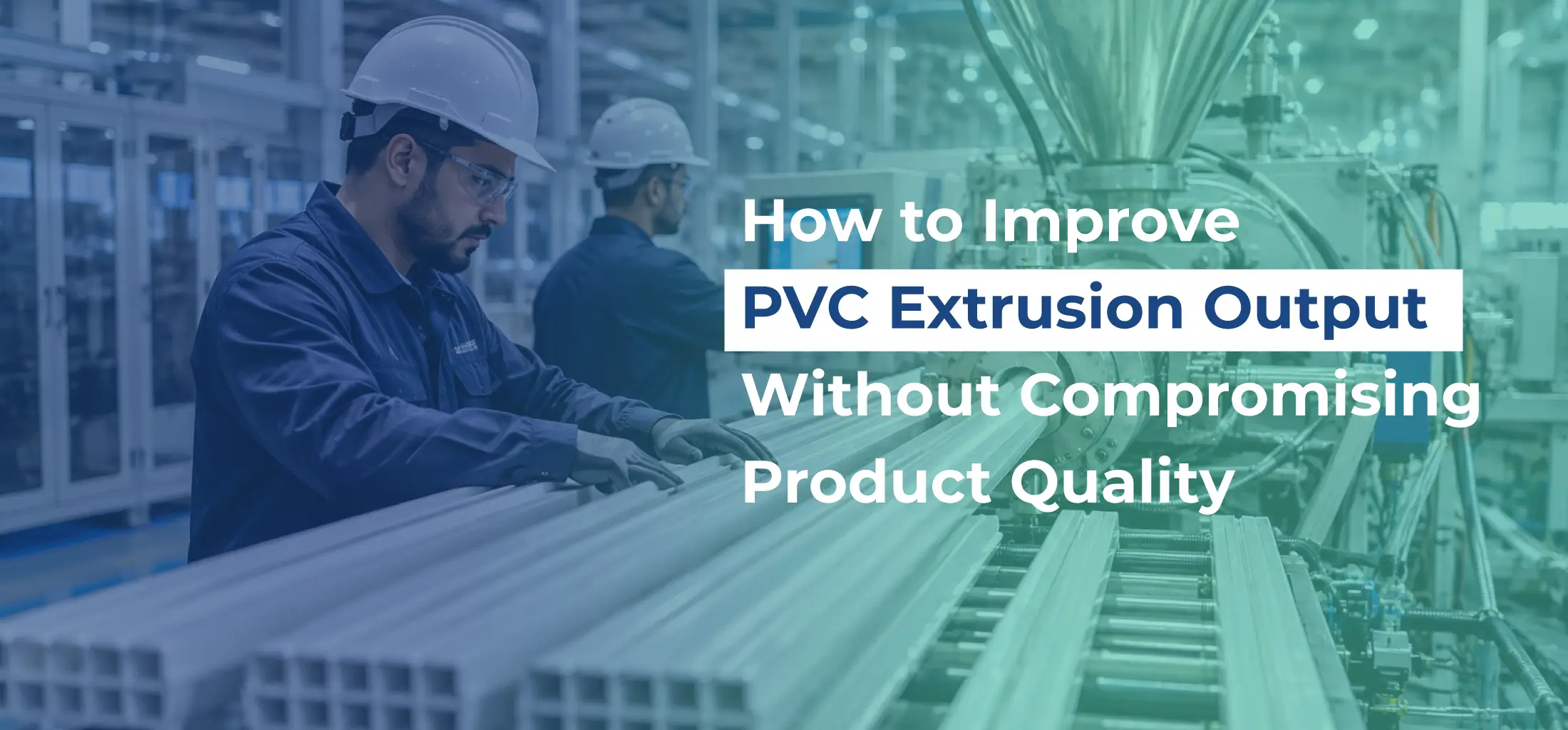
Increasing production output is a key objective for PVC manufacturers. However, running an extrusion line faster does not always mean better productivity.
Higher speeds can lead to problems such as poor surface finish, dimensional instability, melt fracture, inconsistent processing, or increased rejection rates. The real challenge is to improve PVC extrusion output while maintaining consistent product quality.
Achieving this balance requires the right combination of raw materials, formulation, processing conditions, equipment performance, and quality control.
Here are some important ways manufacturers can improve PVC extrusion productivity without compromising the final product.
1. Optimise the PVC Formulation
The formulation is one of the first areas to review when improving extrusion output.
PVC resin, stabilizers, lubricants, processing aids, fillers, pigments, and other additives must work together effectively. An imbalance in the formulation can affect melt flow, fusion, surface quality, and processing stability.
Evaluate:
- PVC resin grade
- Stabilizer system
- Internal and external lubricants
- Processing aids
- Filler levels
- Additive compatibility
- Required product specifications
A well-balanced formulation can improve processing efficiency while maintaining the required mechanical and visual properties.
2. Use the Right PVC Stabilizer System
Thermal stability is critical during PVC extrusion because the material is exposed to heat and mechanical shear.
An appropriate PVC stabilizer helps protect the material during processing and can support consistent fusion, colour stability, and finished-product quality.
The stabilizer system should be selected according to the PVC application, processing conditions, and required performance.
For manufacturers, the objective is not simply to increase extrusion speed but to maintain stable processing at the desired production rate.
3. Optimise Lubrication
Lubrication has a direct impact on PVC processing behaviour.
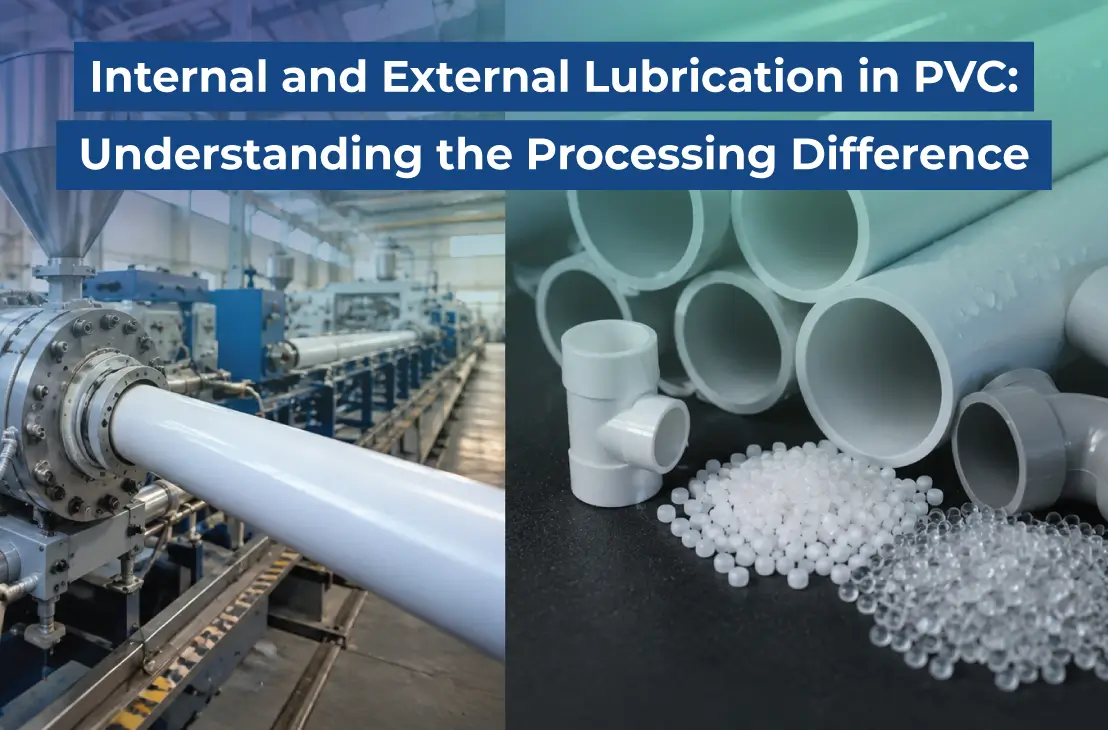
Internal and external lubricants influence friction, melt flow, fusion characteristics, die release, and surface finish. Too little or too much lubrication can create processing issues.
Manufacturers should evaluate:
- Internal lubrication
- External lubrication
- Lubricant balance
- Fusion behaviour
- Die release
- Surface appearance
Optimising the lubricant combination can help the extrusion line operate more efficiently without negatively affecting product quality.
4. Maintain Consistent Raw Material Quality
Variations in raw materials can make extrusion conditions difficult to control.
Changes in resin characteristics, additive quality, moisture, particle size, or filler properties may influence processing performance and finished-product consistency.
Work with reliable chemical raw material suppliers and maintain appropriate incoming quality checks.
Consistent raw materials make it easier to maintain stable extrusion conditions and reduce unnecessary process adjustments.
5. Optimise Extrusion Temperature and Processing Conditions
Extrusion temperature plays an important role in PVC processing.
If temperatures are too low, proper fusion may not be achieved. Excessive temperatures can increase the risk of thermal degradation.
Manufacturers should monitor:
- Barrel temperatures
- Die temperature
- Melt temperature
- Screw speed
- Feed rate
- Pressure
- Torque
The objective should be to establish a stable processing window rather than simply increasing temperature or screw speed to achieve higher output.
6. Increase Line Speed Carefully
Increasing screw speed or feed rate can improve output, but it should be done gradually.
A sudden increase in production speed can result in:
- Higher melt temperature
- Increased shear
- Poor fusion
- Surface defects
- Dimensional variations
- Higher torque
- Material degradation
Monitor product quality at every stage when increasing line speed. The best production rate is the highest stable output that consistently meets product specifications.
7. Improve Fusion and Melt Homogeneity
Proper PVC fusion is essential for achieving consistent mechanical and physical properties.
Poor fusion can result in weak products, rough surfaces, dimensional inconsistencies, or other quality issues.
Review the relationship between:
- Resin characteristics
- Stabilizer system
- Lubrication
- Processing aid
- Screw design
- Temperature profile
- Screw speed
A balanced process can improve melt homogeneity while supporting higher and more consistent output.
8. Maintain the Extrusion Equipment
Equipment condition can directly influence production efficiency.
Worn screws, barrels, dies, heaters, cooling systems, or calibration components can reduce output and create quality problems.
Regularly inspect and maintain:
- Screw and barrel
- Dies
- Heating systems
- Cooling systems
- Vacuum calibration
- Haul-off equipment
- Cutting systems
Preventive maintenance can reduce unplanned downtime and help maintain consistent extrusion performance.
9. Monitor Product Quality During Production
Quality control should not happen only after production is complete.
Real-time monitoring allows manufacturers to identify process variations before they result in large quantities of rejected products.
Depending on the product, monitor parameters such as:
- Dimensions
- Weight
- Surface finish
- Colour
- Hardness
- Mechanical properties
- Melt behaviour
- Production rate
Combining process monitoring with regular quality testing can help manufacturers increase output while keeping rejection rates under control.
10. Reduce Production Waste and Rejections
Higher output has limited value if it also produces significantly more waste.
Manufacturers should identify the main causes of:
- Start-up waste
- Dimensional rejection
- Surface defects
- Colour variation
- Poor fusion
- Material degradation
- Off-specification products
Reducing these losses can improve effective production output without necessarily increasing machine speed.
11. Work With a Technical Chemical Partner
Optimising PVC extrusion is not always about changing machine settings.
The interaction between PVC resin, stabilizers, lubricants, processing aids, and other additives can have a significant impact on processing performance.
A technically experienced chemical supplier can help manufacturers evaluate formulations, identify processing challenges, and select suitable additive systems.
This can be especially valuable when manufacturers are trying to increase output while maintaining the same quality specifications.
Why Nimbasia Stabilizers Can Support PVC Processing
Nimbasia Stabilizers develops specialty chemical solutions for industrial applications, including PVC stabilizers, metallic stearates, 12-hydroxy stearates, and lubricating agents.
With a focus on consistent quality, technical expertise, and application-oriented solutions, Nimbasia supports manufacturers looking to improve processing efficiency while maintaining product performance.
The right combination of stabilizers and lubricating agents can contribute to:
- Processing stability
- Thermal protection
- Consistent product quality
- Improved surface finish
- Better processing efficiency
- Application-specific performance
Selecting the right additive system should always be based on the formulation, extrusion process, and final product requirements.
Final Thought
Improving PVC extrusion output is not simply about running the machine faster. It is about creating a stable and efficient process that delivers higher productivity without sacrificing consistency or product quality.
From formulation and additive selection to temperature control, equipment maintenance, and quality monitoring, every part of the extrusion process contributes to the final result.
By optimising these factors and working with a reliable technical chemical partner, PVC manufacturers can achieve a better balance between output, efficiency, consistency, and product performance.
Frequently Asked Questions (FAQs)
-
Which is the Best PVC Stabilizer for Extrusion?
The best PVC stabilizer depends on the PVC application, formulation, processing conditions, and required performance. Nimbasia Stabilizers offers PVC stabilizer and additive solutions designed to support processing stability, thermal protection, and consistent product quality.
-
How can I increase PVC extrusion output without affecting quality?
Optimise the PVC formulation, stabilizer and lubricant system, processing temperatures, screw speed, equipment condition, and quality-control processes before gradually increasing production speed.
-
How do PVC stabilizers affect extrusion?
PVC stabilizers help protect the material from thermal degradation during processing and can support consistent colour, fusion, and product performance.
-
Can lubricants improve PVC extrusion efficiency?
Yes. The correct balance of internal and external lubricants can influence friction, fusion, melt flow, die release, and surface finish.
-
Does increasing screw speed always increase PVC output?
Not necessarily. Higher screw speeds can increase output but may also increase shear, melt temperature, torque, and the risk of processing defects. The optimum speed depends on the formulation and equipment.
-
How can manufacturers reduce PVC extrusion rejection rates?
Maintaining consistent raw materials, optimising processing conditions, monitoring product quality during production, and identifying the causes of surface, dimensional, colour, or fusion defects can help reduce rejection.
-
Why is equipment maintenance important for PVC extrusion?
Worn or poorly maintained extrusion equipment can reduce production efficiency and create inconsistent product quality. Regular inspection and preventive maintenance help maintain stable performance.
-
Why is choosing the right chemical supplier important for PVC extrusion?
A technically capable chemical supplier can provide consistent additives, application guidance, and formulation support, helping manufacturers optimise processing while maintaining product quality.