
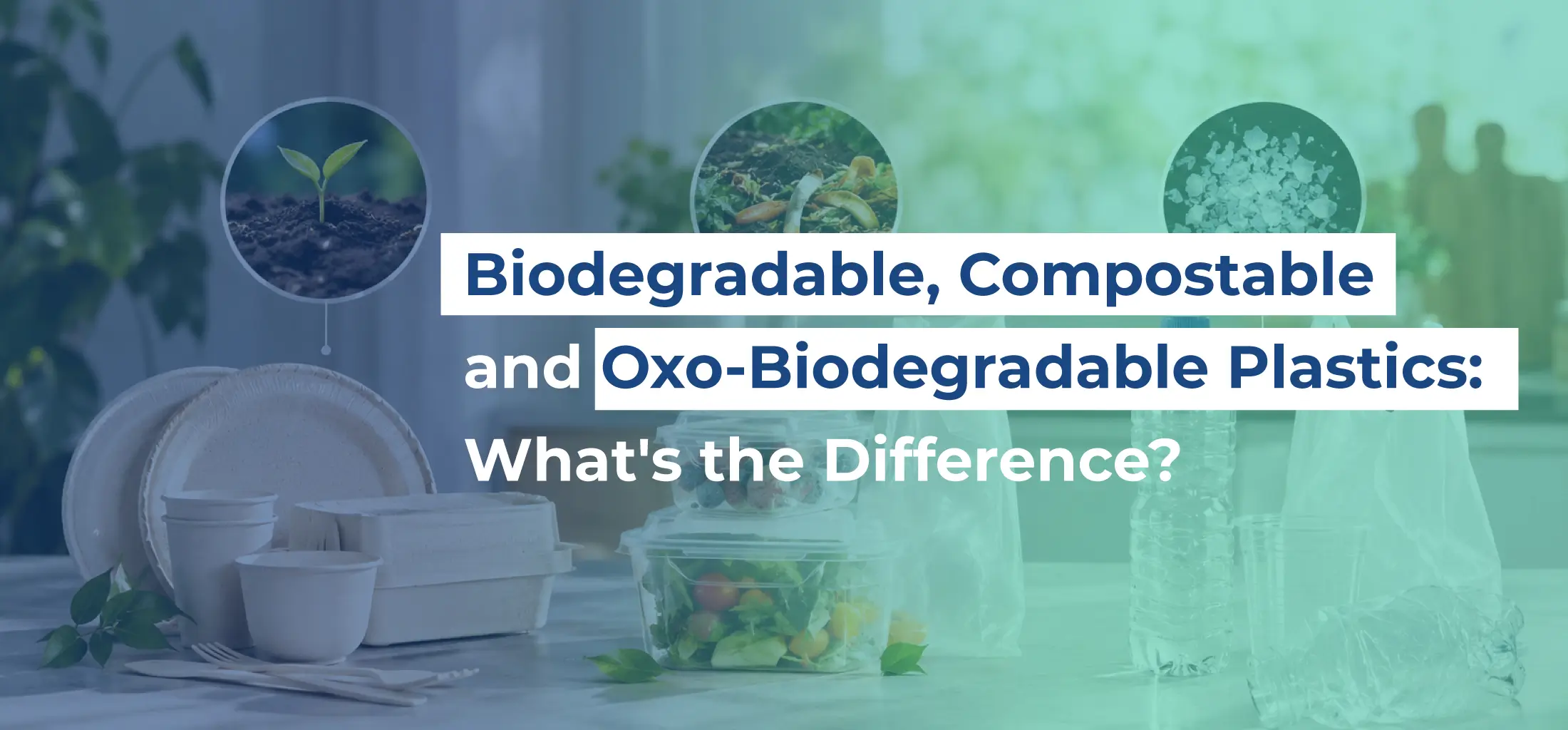
As industries move toward more sustainable materials, terms such as biodegradable plastics, compostable plastics, and oxo-biodegradable plastics are becoming increasingly common. While these materials are often discussed as alternatives to conventional plastics, they do not have the same properties, degradation mechanisms, or environmental outcomes.
Understanding the difference between these types of plastics is important for manufacturers, product developers, packaging companies, and businesses looking to select materials based on their application and sustainability requirements.
In this article, we explain the key differences between biodegradable, compostable, and oxo-biodegradable plastics, how they work, where they are used, and what factors should be considered when choosing between them.
What Are Biodegradable Plastics?
Biodegradable plastics are plastics that can be broken down by microorganisms such as bacteria and fungi under suitable environmental conditions.
During biodegradation, microorganisms consume the polymer or its breakdown products and convert them into substances such as carbon dioxide, water, biomass, and, under anaerobic conditions, methane.
However, the term "biodegradable" does not necessarily mean that a plastic will break down quickly in every environment.
The rate and extent of biodegradation depend on factors such as:
- Temperature
- Moisture
- Oxygen availability
- Microbial activity
- Polymer structure
- Thickness of the plastic
- Environmental conditions
Therefore, a biodegradable plastic may require specific conditions to degrade effectively.
How Do Biodegradable Plastics Work?
Biodegradable plastics can contain polymers designed to undergo degradation through microbial activity.
The process generally involves:
- Polymer degradation - The polymer structure begins breaking down.
- Fragmentation - Larger polymer chains are converted into smaller molecules.
- Microbial action - Microorganisms consume the resulting compounds.
- Biological conversion - The material is converted into simpler substances such as carbon dioxide, water, and biomass under suitable conditions.
The actual degradation rate varies significantly between materials and environments.
Applications of Biodegradable Plastics
Biodegradable plastics can be considered for various applications where end-of-life characteristics are important.
Common areas include:
- Packaging - Biodegradable polymers can be used in selected packaging applications where appropriate material performance and disposal conditions are available.
- Agriculture - Biodegradable plastics can be used in certain agricultural applications, including products designed to reduce the need for plastic collection after use.
- Food-Service Products - Certain biodegradable materials can be used in disposable food-service products, depending on food-contact requirements and end-of-life conditions.
- Specialty Applications - Biodegradable polymers are also being developed for various specialty applications where controlled degradation is desirable.
What Are Compostable Plastics?
Compostable plastics are a specific category of biodegradable plastics designed to break down under defined composting conditions.
When properly composted, compostable plastics are intended to decompose into materials such as carbon dioxide, water, and biomass without leaving persistent plastic residues, subject to the applicable standard and certification requirements.
Compostable plastics are commonly used in applications such as:
- Food packaging
- Compostable bags
- Disposable food-service products
- Agricultural applications
- Organic-waste collection bags
- Food-service packaging
An important point is that compostable does not automatically mean that the material will break down in ordinary soil, oceans, or landfills. Many compostable plastics are designed specifically for industrial composting environments.
How Do Compostable Plastics Work?
Compostable plastics are designed to break down under specified composting conditions.
A typical composting environment provides factors such as:
- Controlled temperature
- Moisture
- Oxygen
- Microbial activity
- Suitable composting duration
Under these conditions, the material can break down and contribute to the composting process, provided it meets the relevant compostability requirements.
Applications of Compostable Plastics
Compostable plastics are particularly relevant in applications where the product is likely to enter a composting or organic-waste management system.
Common applications include:
- Compostable shopping bags
- Food-waste collection bags
- Food packaging
- Fresh produce packaging
- Disposable food-service products
- Agricultural films
- Compostable cutlery and other products
The suitability of the material depends on the required mechanical, thermal, barrier, and processing properties as well as the available disposal infrastructure
What Are Oxo-Biodegradable Plastics?
Oxo-biodegradable plastics are conventional plastic materials containing additives designed to promote oxidation and fragmentation of the polymer when exposed to environmental factors such as heat, oxygen, and UV radiation.
The oxidation process can cause the plastic material to become brittle and fragment into smaller pieces.
Oxo-degradable and oxo-biodegradable plastics are therefore different from materials that biodegrade through microbial action from the beginning.
Their environmental performance and terminology have also been the subject of significant discussion, particularly regarding whether fragmentation should be considered true biodegradation and the potential formation of microplastic residues.
How Do Oxo-Biodegradable Plastics Work?
Oxo-biodegradable plastics generally use additives that promote oxidation of the polymer.
The process can involve:
Oxidation → Polymer chain breakdown → Fragmentation → Further degradation
Heat, oxygen, and UV exposure can influence this process.
However, the exact environmental outcome depends on the formulation, additive system, environmental conditions, and the extent of subsequent biodegradation.
Applications of Oxo-Biodegradable Plastics
Oxo-biodegradable technologies have historically been considered for certain conventional plastic applications where controlled degradation characteristics are desired.
Potential applications have included:
- Plastic bags
- Packaging films
- Agricultural products
- Disposable plastic products
However, manufacturers should carefully evaluate regulatory requirements, environmental claims, and end-of-life performance before selecting oxo-biodegradable technology.
Biodegradable vs Compostable vs Oxo-Biodegradable Plastics
Although the three terms are sometimes used interchangeably, they describe different material characteristics and degradation pathways.
| Feature | Biodegradable Plastics | Compostable Plastics | Oxo-Biodegradable Plastics |
|---|---|---|---|
| Basic concept | Break down through biological activity | Designed to biodegrade under composting conditions | Oxidative degradation followed by fragmentation and potential biodegradation |
| Main mechanism | Microbial degradation | Microbial degradation under defined conditions | Oxidation and fragmentation |
| Requires specific conditions? | Often | Usually, depending on certification | Yes, environmental exposure influences performance |
| Composting application | May or may not be suitable | Specifically designed for composting applications | Not generally classified as compostable |
| Common applications | Packaging, agricultural and specialty products | Food packaging, bags, food-service products | Certain conventional plastic applications |
| Certification importance | High | Very high | Important for evaluating environmental claims |
What Is the Difference Between Biodegradable and Compostable Plastics?
The biggest difference is that compostable plastics are a defined subset of biodegradable materials designed to meet specific composting requirements.
A biodegradable plastic may break down biologically under certain environmental conditions, but that does not necessarily mean it is suitable for a composting facility.
Compostable plastics, on the other hand, are developed and tested against specific requirements for composting environments.
For manufacturers, this distinction is important because the correct material should be selected according to the intended disposal pathway and application.
What Is the Difference Between Biodegradable and Oxo-Biodegradable Plastics?
Biodegradable plastics rely primarily on biological processes involving microorganisms.
Oxo-biodegradable plastics use additives that promote oxidation and physical breakdown of the plastic before or alongside further degradation.
This means their degradation pathways are fundamentally different.
When evaluating oxo-biodegradable materials, manufacturers should consider the complete degradation process rather than assuming that faster fragmentation automatically means complete biodegradation.
What Is the Difference Between Compostable and Oxo-Biodegradable Plastics?
Compostable plastics are specifically designed for composting conditions and must meet applicable compostability requirements.
Oxo-biodegradable plastics, in contrast, rely on oxidation and fragmentation and should not automatically be considered compostable.
Therefore, if a product is intended for an organic-waste collection or composting application, a certified compostable material may be more appropriate than an oxo-biodegradable plastic.
Key Factors to Consider When Choosing Sustainable Plastic Materials
Selecting the right material involves more than simply choosing a plastic described as biodegradable or compostable.
Manufacturers should consider:
1. Intended Application
Determine whether the material will be used for packaging, agriculture, food service, industrial products, or another application.
2. Required Performance
Consider:
- Tensile strength
- Flexibility
- Impact resistance
- Heat resistance
- Moisture resistance
- Barrier properties
- Shelf life
3. Processing Requirements
The material must be compatible with the intended manufacturing process, such as:
- Extrusion
- Injection molding
- Blow molding
- Thermoforming
- Film production
4. End-of-Life Conditions
Consider where the product is expected to go after use.
For example, a compostable material may require access to an appropriate composting system to achieve its intended end-of-life performance.
5. Certifications and Standards
Environmental claims should be supported by relevant testing, standards, and certifications applicable to the intended market and application.
6. Regulatory Requirements
Manufacturers should review applicable local and international regulations before selecting a material or making environmental claims.
Benefits of Using Alternative Plastic Technologies
Depending on the material and application, biodegradable and compostable plastics can offer several potential advantages:
- Support for alternative end-of-life pathways
- Reduced reliance on conventional plastic materials in selected applications
- Suitability for organic-waste management systems in the case of certified compostable products
- Opportunities for more sustainable product development
- Compatibility with evolving packaging and material requirements
However, the environmental benefit depends on the complete product lifecycle, including raw materials, manufacturing, transportation, use, collection, and disposal.
Why Material Selection Matters
There is no single sustainable plastic material that is suitable for every application.
A material that works well for compostable food packaging may not provide the mechanical or thermal performance required for an industrial product.
Similarly, a biodegradable polymer may require specific environmental conditions that are not available in a particular waste-management system.
For this reason, manufacturers should evaluate both material performance and end-of-life requirements before selecting a biodegradable, compostable, or oxo-biodegradable solution.
Why Choose Nimbasia Stabilizers for Polymer Additives and Material Solutions?
Nimbasia Stabilizers provides specialty chemical and polymer additive solutions for industrial applications.
With experience across polymer-related industries, Nimbasia Stabilizers focuses on solutions that can support processing performance, material functionality, and application-specific requirements.
When developing plastic formulations, manufacturers need to consider not only the base polymer but also the role of additives, stabilizers, lubricants, and other formulation components.
Working with an experienced supplier can help manufacturers evaluate the right combination of materials and additives for their specific processing and performance requirements.
Conclusion
Biodegradable, compostable, and oxo-biodegradable plastics are not the same.
Biodegradable plastics are designed to break down through biological processes under suitable conditions. Compostable plastics are a more specifically defined category intended to biodegrade under appropriate composting conditions. Oxo-biodegradable plastics use oxidation-promoting additives to encourage polymer degradation and fragmentation.
The right choice depends on the application, required performance, processing method, environmental conditions, disposal pathway, certifications, and regulatory requirements.
As industries continue to explore more sustainable material solutions, understanding these differences can help manufacturers make better-informed decisions and develop products with appropriate end-of-life considerations.
Frequently Asked Questions (FAQs)
-
How can Nimbasia help with polymer applications?
Nimbasia Stabilizers offers specialty chemical and polymer additive solutions that can support different industrial formulation and processing requirements. The appropriate solution depends on the polymer, application, processing conditions, and desired performance.
-
What is the difference between biodegradable and compostable plastics?
Biodegradable plastics can break down through biological processes under suitable conditions. Compostable plastics are specifically designed to biodegrade under defined composting conditions and meet applicable compostability requirements.
-
Are compostable plastics biodegradable?
Yes. Compostable plastics are designed to biodegrade under specified composting conditions. However, not every biodegradable plastic is necessarily compostable.
-
Are oxo-biodegradable plastics the same as compostable plastics?
No. Oxo-biodegradable plastics rely on oxidation and fragmentation, while compostable plastics are designed to biodegrade under defined composting conditions.
-
Which is better: biodegradable or compostable plastic?
Neither is universally better. The appropriate choice depends on the application, performance requirements, disposal pathway, and applicable standards.
-
Do biodegradable plastics completely disappear?
The extent and rate of degradation depend on the polymer and environmental conditions. A product labelled biodegradable should therefore be evaluated based on the specific conditions under which biodegradation is expected.
-
Are compostable plastics suitable for normal landfills?
Not necessarily. Many compostable plastics are designed for specific composting environments and may not achieve the same degradation performance in a landfill.
-
Are oxo-biodegradable plastics environmentally friendly?
Their environmental performance depends on the formulation, degradation conditions, and what happens after fragmentation. Claims should be evaluated based on relevant testing, standards, and regulations rather than the term alone.
-
What is the best plastic material for sustainable packaging?
There is no single best material for every application. The right choice depends on packaging requirements, product shelf life, processing conditions, disposal infrastructure, certifications, and regulatory requirements.