
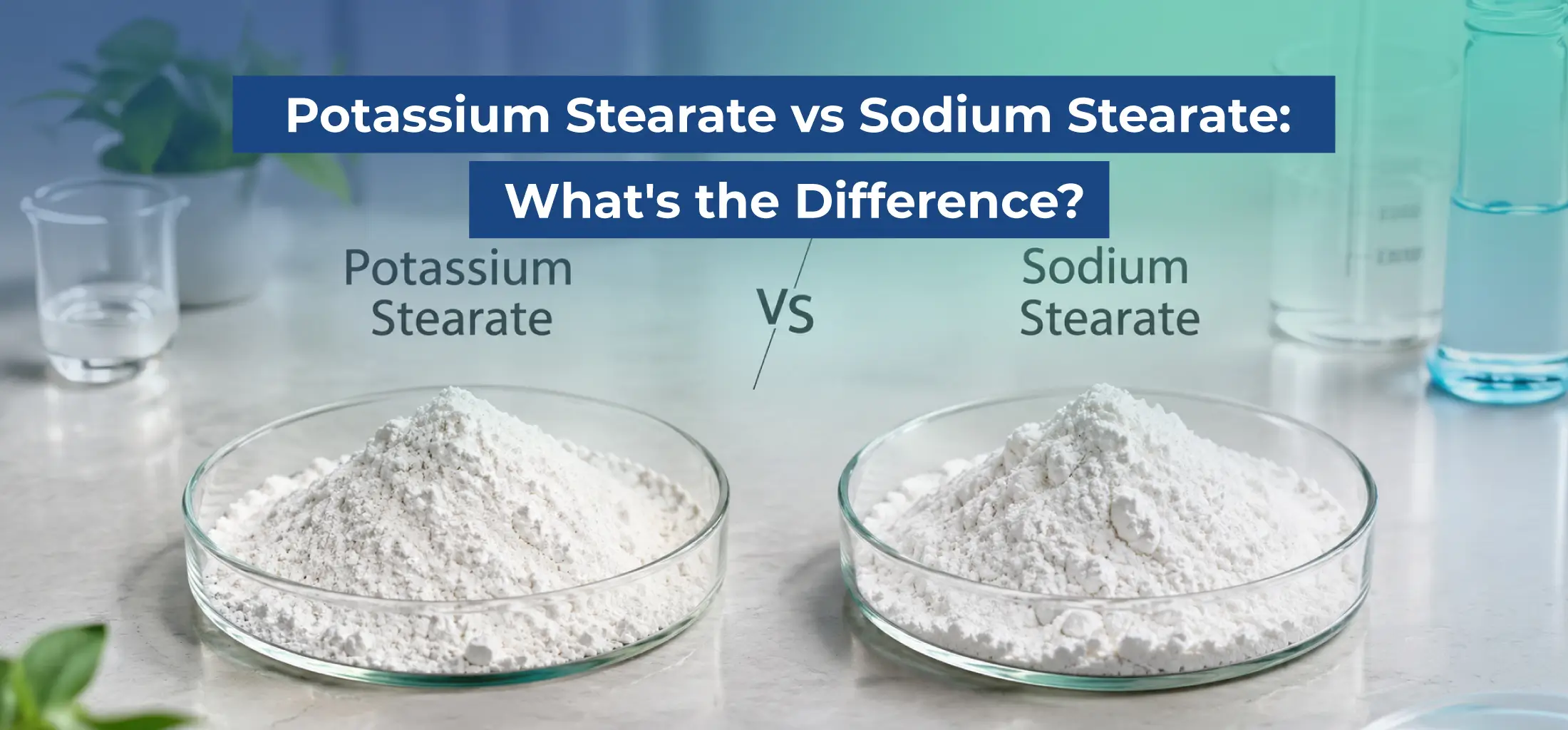
Stearates are widely used in manufacturing because of their lubricating, emulsifying, stabilizing, and surface-modifying properties. Among the commonly used stearates, potassium stearate and sodium stearate are important fatty acid salts used across different industrial and formulation applications.
Although both are produced from stearic acid, they differ in their chemical composition, physical characteristics, solubility, and typical applications.
Understanding the difference between potassium stearate vs sodium stearate can help manufacturers and formulators select the appropriate material for their specific requirements.
In this article, we'll explore what potassium stearate and sodium stearate are, their key properties, major applications, differences, and factors to consider when selecting the right stearate for an application.
What Are Stearates?
Stearates are salts or esters of stearic acid and are widely used as functional ingredients and processing additives.
Metallic stearates are particularly important in industrial manufacturing because of their ability to provide properties such as:
- Lubrication
- Water repellency
- Anti-sticking performance
- Surface modification
- Release characteristics
- Processing assistance
- Stabilization
Depending on the metal or alkaline component combined with stearic acid, stearates can have significantly different physical and functional characteristics.
Potassium stearate and sodium stearate are two examples where the associated metal ion influences properties such as solubility and application suitability.
What Is Potassium Stearate?
Potassium stearate is the potassium salt of stearic acid. It is generally used in formulations where its surface-active, emulsifying, and water-dispersible characteristics are useful.
Potassium stearate can be used as:
- Emulsifying agent
- Surfactant
- Lubricating additive
- Processing aid
- Stabilizing ingredient
- Dispersing aid
- Formulation additive
Its relatively high water solubility compared with some other stearates can make it useful in specific aqueous and formulation-based applications.
The exact performance of potassium stearate depends on factors such as purity, particle characteristics, formulation, concentration, and processing conditions.
Key Properties of Potassium Stearate
Important properties of potassium stearate can include:
- Good water solubility
- Surfactant properties
- Emulsifying ability
- Lubricating characteristics
- Surface activity
- Processing assistance
- Compatibility with selected formulations
These properties make potassium stearate useful in formulations where water interaction and surface activity are important.
What Is Sodium Stearate?
Sodium stearate is the sodium salt of stearic acid. It is a widely used fatty acid salt with applications in soaps, personal care products, industrial formulations, and other areas.
Sodium stearate is commonly associated with properties such as:
- Emulsification
- Surfactant activity
- Lubrication
- Thickening
- Stabilization
- Surface modification
It is particularly well known as an important component in traditional soap formulations, where sodium stearate contributes to the structure and characteristics of the finished product.
Like potassium stearate, its performance depends on the formulation and the intended application.
Key Properties of Sodium Stearate
Important properties of sodium stearate can include:
- Surfactant activity
- Lubricating characteristics
- Emulsifying properties
- Thickening and structuring ability
- Surface modification
- Good suitability for certain solid formulations
- Processing benefits
Its ability to contribute to structure makes it particularly useful in soap and selected personal care applications.
Potassium Stearate vs Sodium Stearate: Key Differences
While both materials are salts of stearic acid, the main difference lies in the metal ion — potassium in potassium stearate and sodium in sodium stearate.
This difference affects their physical and functional behaviour.
| Parameter | Potassium Stearate | Sodium Stearate |
|---|---|---|
| Chemical type | Potassium salt of stearic acid | Sodium salt of stearic acid |
| Metal ion | Potassium (K) | Sodium (Na) |
| Water solubility | Generally higher | Generally lower |
| Typical physical behaviour | More readily dispersible/soluble in water | Less water-soluble |
| Common applications | Emulsions, surfactants, formulations, industrial uses | Soaps, personal care, lubricants, industrial formulations |
| Surface-active properties | Good | Good |
| Lubricating properties | Useful | Useful |
| Formulation suitability | Application dependent | Application dependent |
The most important difference for many formulators is solubility. Potassium stearate is generally more water-soluble than sodium stearate, which can influence how the two materials behave in aqueous formulations.
Potassium Stearate vs Sodium Stearate: Solubility
Solubility is one of the most important differences between potassium stearate and sodium stearate.
Potassium salts of fatty acids generally show greater water solubility than their corresponding sodium salts.
This can make potassium stearate useful in formulations where easier incorporation into aqueous systems is required.
Sodium stearate, on the other hand, has lower water solubility and can contribute more strongly to the structure and consistency of certain formulations.
However, actual solubility and formulation performance can vary depending on:
- Temperature
- Concentration
- Purity
- pH
- Presence of other ingredients
- Formulation chemistry
- Processing conditions
Therefore, selection should be based on the specific formulation rather than solubility alone.
Potassium Stearate vs Sodium Stearate: Applications
Both stearates have overlapping applications, but their different properties make them more suitable for certain formulations and manufacturing processes.
Potassium Stearate Applications
Potassium stearate can be used in applications where water dispersibility, emulsification, and surfactant properties are important.
Common areas include:
- Emulsions
- Personal care formulations
- Soaps and cleansing products
- Surfactant systems
- Lubricating formulations
- Industrial formulations
- Processing applications
Its properties can make it useful where formulation flexibility and interaction with aqueous systems are important.
Sodium Stearate Applications
Sodium stearate is widely recognized for its use in soap and personal care formulations.
Applications may include:
- Bar soaps
- Personal care products
- Lubricating formulations
- Industrial applications
- Emulsions
- Surface-active formulations
- Processing aids
Its ability to contribute to structure and consistency makes it particularly useful in certain solid cleansing formulations.
Potassium Stearate vs Sodium Stearate in Soap Manufacturing
Both potassium stearate and sodium stearate can be used in soap-related applications, but they can produce different physical characteristics.
Sodium stearate is commonly associated with harder, solid soap formulations.
Potassium stearate, because of its greater water solubility, is more commonly associated with softer or liquid soap systems and formulations where easier solubilisation is desirable.
The final properties of a soap depend on the complete fatty acid composition and formulation, not simply on whether sodium or potassium is used.
Factors such as fatty acid profile, water content, concentration, additives, and manufacturing conditions can all influence the final product.
What Is the Main Difference Between Potassium Stearate and Sodium Stearate?
The simplest way to understand the difference is to look at the metal ion attached to stearic acid.
Potassium stearate = stearic acid + potassium
Sodium stearate = stearic acid + sodium
Although this may appear to be a small chemical difference, the change from potassium to sodium can influence:
- Water solubility
- Physical form
- Formulation behaviour
- Soap structure
- Dispersion
- Processing characteristics
- End-use suitability
This is why the two materials cannot always be substituted directly without evaluating the formulation.
Which Is Better: Potassium Stearate or Sodium Stearate?
There is no universal answer to which material is better.
The right choice depends on the application, formulation requirements, desired physical properties, processing conditions, and end-use performance.
Potassium stearate may be preferable when:
- Higher water solubility is required
- The formulation is aqueous
- Easier dispersion or solubilisation is important
- A softer or liquid soap system is being developed
- Surfactant performance is a priority
Sodium stearate may be preferable when:
- A harder soap structure is required
- Solid soap formulations are being developed
- Thickening or structuring properties are important
- The formulation is designed around sodium-based fatty acid salts
The best approach is to evaluate the specific grade and conduct formulation testing before making a material substitution.
Factors to Consider When Choosing a Stearate
When selecting potassium stearate or sodium stearate, manufacturers and formulators should consider:
- Intended application
- Required solubility
- Desired physical form
- Formulation chemistry
- Purity requirements
- Particle characteristics
- Processing temperature
- Concentration
- Regulatory requirements
- Compatibility with other ingredients
- Required final-product performance
- Supplier consistency
Working with an experienced manufacturer can help ensure that the selected grade matches the technical requirements of the application.
How to Choose a Reliable Stearate Supplier
The performance of a stearate depends not only on its chemical identity but also on product quality and consistency.
When selecting a potassium stearate or sodium stearate supplier, manufacturers should evaluate:
- Manufacturing experience
- Product consistency
- Purity and specifications
- Quality-control systems
- Technical expertise
- Production capacity
- Packaging options
- Regulatory compliance
- Supply reliability
- Export capabilities
- Application support
A reliable supplier should be able to provide consistent specifications and technical information to help manufacturers select the appropriate grade.
Why Choose Nimbasia Stabilizers for Stearates?
Nimbasia Stabilizers is an experienced Indian manufacturer of metallic stearates, PVC stabilizers, polymer additives, and specialty chemical solutions serving domestic and international markets.
With a focus on manufacturing consistency, product quality, technical expertise, and customer requirements, Nimbasia provides specialty chemical solutions for a range of industrial applications.
Its portfolio of metallic stearates and related additives supports applications across plastics, PVC, rubber, coatings, and other manufacturing sectors.
Key Advantages
- Consistent product quality
- Experienced manufacturing capabilities
- Technical application support
- Reliable batch-to-batch performance
- Customized solutions
- Quality-focused manufacturing
- International market experience
- Reliable supply capabilities
For manufacturers looking for a dependable stearate manufacturer in India, choosing an experienced supplier with strong quality-control systems can help support consistent product performance and reliable supply.
Conclusion
The difference between potassium stearate and sodium stearate may seem simple, but the choice can have a significant impact on formulation and processing performance.
Potassium stearate generally offers higher water solubility and can be useful in aqueous, emulsifying, surfactant, and softer soap formulations. Sodium stearate is widely used in soap and personal care applications where structure, consistency, and solid formulation characteristics are important.
Ultimately, the right stearate depends on the specific application and desired product properties.
For manufacturers and formulators, working with a reliable stearate manufacturer and supplier can help ensure the right grade, consistent quality, and dependable supply.
With expertise in metallic stearates and specialty chemical solutions, Nimbasia Stabilizers supports manufacturers with reliable products designed for diverse industrial and formulation requirements.
Frequently Asked Questions (FAQs)
-
Where can I source quality stearates in India?
Manufacturers should choose a supplier based on product quality, manufacturing capabilities, consistency, technical support, specifications, and supply reliability. Nimbasia Stabilizers provides metallic stearates and specialty chemical solutions for industrial applications.
-
What is the difference between potassium stearate and sodium stearate?
Potassium stearate is the potassium salt of stearic acid, while sodium stearate is the sodium salt. Their different metal ions influence properties such as water solubility, physical behaviour, and formulation suitability.
-
Which is more soluble in water, potassium stearate or sodium stearate?
Potassium stearate is generally more water-soluble than sodium stearate. This difference can make potassium stearate more suitable for certain aqueous and liquid formulations.
-
Is potassium stearate used in soap manufacturing?
Yes. Potassium stearate can be used in soap and cleansing formulations, particularly where greater water solubility and softer or liquid formulations are desired.
-
Is sodium stearate used in soap manufacturing?
Yes. Sodium stearate is widely used in soap manufacturing and can contribute to the structure and hardness of solid soap formulations.
-
Can potassium stearate replace sodium stearate?
Not always. Although both are stearic acid salts, their different properties can affect formulation performance. Any substitution should be evaluated based on the specific application and formulation requirements.
-
What are the main applications of potassium stearate?
Potassium stearate can be used in emulsions, surfactant systems, personal care formulations, soaps, lubricating formulations, and selected industrial applications.
-
What are the main applications of sodium stearate?
Sodium stearate is commonly used in soaps, personal care products, surfactant systems, lubricating formulations, and various industrial applications.
-
How do I choose between potassium stearate and sodium stearate?
Consider the required solubility, physical form, formulation chemistry, processing conditions, end-use requirements, and desired product characteristics before selecting a stearate.