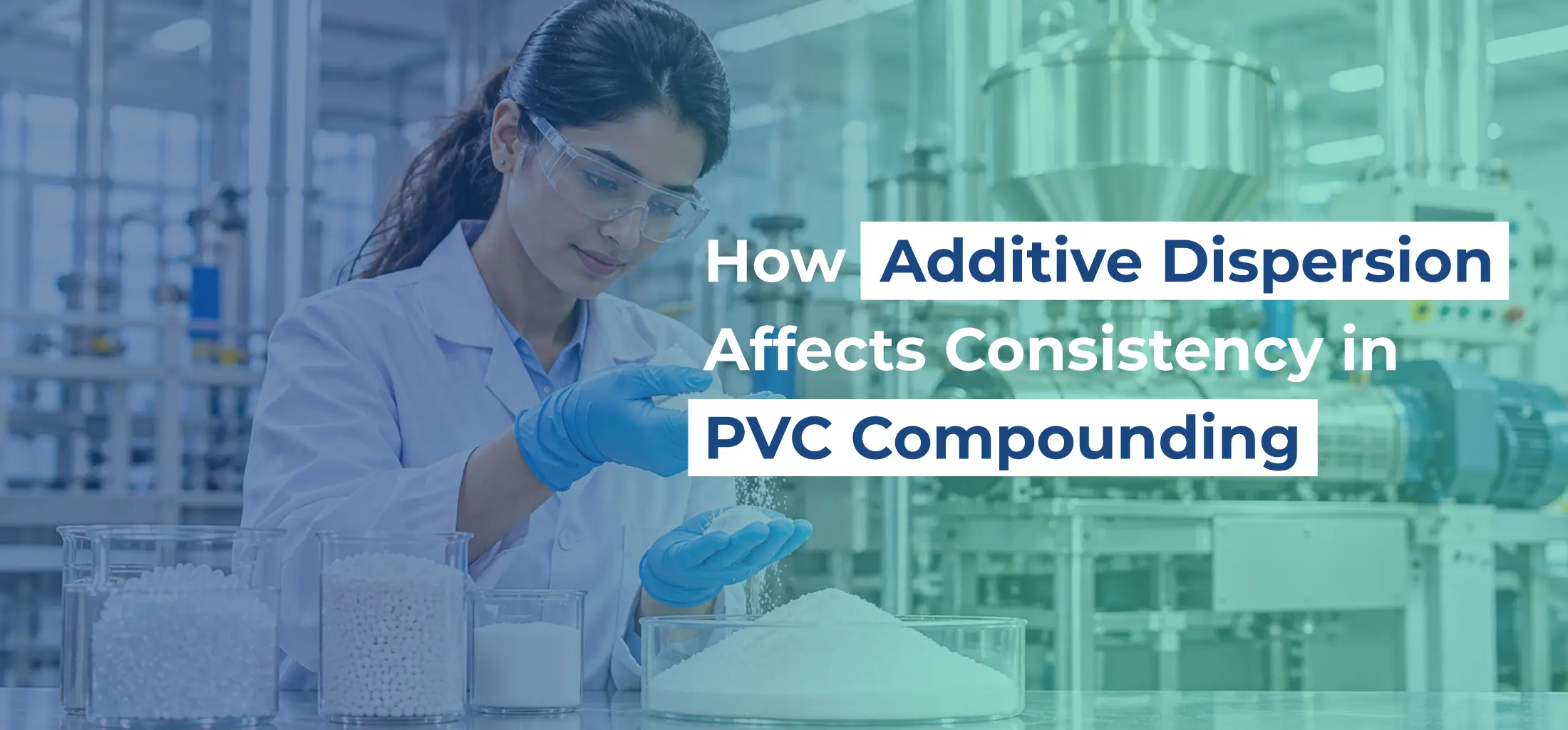
In PVC manufacturing, achieving consistent product quality depends on more than selecting the right raw materials. How effectively these materials are distributed throughout the PVC compound also plays a critical role in determining its final properties, processing behaviour, and overall performance.
Additives such as heat stabilizers, lubricants, processing aids, and impact modifiers serve specific functions during PVC compounding. However, if these additives are not uniformly dispersed, manufacturers may experience processing variations, inconsistent mechanical properties, surface defects, and reduced product quality.
Understanding the importance of additive dispersion in PVC compounding can help manufacturers improve formulation efficiency, maintain production consistency, and achieve better-performing finished products.
1. Understanding Additive Dispersion in PVC Compounding
Additive dispersion refers to the uniform distribution of different additives throughout a PVC resin matrix during the compounding process.
Each additive performs a particular function. For example:
- Calcium-Zinc Stabilizers : Help protect PVC against thermal degradation during processing.
- Calcium Stearate : Functions as a lubricant and processing aid in suitable PVC formulations.
- Metal Stearates : Support lubrication, processing, and other formulation-specific requirements.
- Processing Aids : Improve fusion behaviour and melt processing.
- Impact Modifiers : Enhance the impact resistance of finished PVC products.
When these additives are distributed properly, they can perform their intended functions more effectively. Poor dispersion, on the other hand, may result in uneven additive concentration and inconsistent product characteristics.
2. How Poor Additive Dispersion Affects PVC Product Quality
Inconsistent additive distribution can create several challenges during PVC compounding and subsequent processing.
- Uneven Thermal Stabilisation : Poor distribution of PVC heat stabilizers may lead to variations in thermal protection, increasing the risk of discolouration and thermal degradation in certain areas of the compound.
- Inconsistent Lubrication : Uneven distribution of calcium stearate and other lubricants can affect melt flow, fusion, processing behaviour, and surface finish.
- Variation in Mechanical Properties : Improper dispersion of impact modifiers and other functional additives may result in inconsistent strength, toughness, and impact performance.
- Surface Defects : Poorly dispersed additives can contribute to visible imperfections, rough surfaces, or processing-related defects in finished PVC products.
- Production Variations : Inconsistent additive performance can affect extrusion, moulding, processing temperatures, and overall production efficiency.
3. Factors That Influence Additive Dispersion in PVC Formulations
Achieving uniform additive dispersion requires attention to multiple factors throughout the compounding process.
Raw Material Compatibility
The physical and chemical characteristics of PVC resin and additives influence how effectively they interact during mixing. Selecting compatible additives based on the intended PVC application is an important starting point.
Mixing Temperature and Speed
Mixing conditions influence additive distribution and the absorption of additives into the PVC resin. Temperature, mixing speed, and mixing time should be controlled according to the formulation and processing requirements.
Additive Particle Size
Particle size and physical characteristics can influence the distribution of additives within the PVC compound. Consistent particle properties help support predictable mixing and processing behaviour.
Addition Sequence
The order in which stabilizers, lubricants, and other additives are introduced can influence mixing efficiency and overall dispersion. Manufacturers should establish an appropriate addition sequence based on their formulation.
Equipment and Processing Conditions
The design, condition, and operating parameters of high-speed mixers, cooling mixers, and compounding equipment can affect additive distribution and compound uniformity.
4. The Role of Calcium-Zinc Stabilizers in Consistent PVC Compounding
Heat stabilizers are essential components of PVC formulations because PVC is sensitive to heat during processing.
Calcium-zinc stabilizers are widely used in PVC applications where thermal stability and suitable processing performance are required.
However, their effectiveness also depends on factors such as formulation compatibility, dosage, mixing conditions, and dispersion quality.
Uniform distribution of calcium-zinc stabilizers helps support consistent thermal protection throughout the PVC compound. This is particularly important in applications such as PVC pipes, profiles, fittings, and other processed PVC products.
Choosing suitable stabilizer grades from an experienced calcium-zinc stabilizer manufacturer can help PVC processors develop formulations aligned with their production requirements.
5. How to Improve Additive Dispersion During PVC Compounding
Manufacturers can take several practical steps to improve additive distribution and maintain consistent PVC compound quality.
- Select Suitable Additives : Choose stabilizers, lubricants, and processing aids based on the PVC application and formulation requirements.
- Optimise Mixing Parameters : Maintain appropriate mixing temperatures, speeds, and durations.
- Follow a Controlled Addition Sequence : Introduce additives in a consistent order to support uniform distribution.
- Monitor Raw Material Quality : Evaluate incoming additives for consistency in physical and technical properties.
- Conduct Regular Quality Testing : Assess thermal stability, fusion characteristics, mechanical properties, and surface finish as relevant to the application.
- Maintain Equipment : Regularly inspect and maintain mixing and compounding equipment to avoid variations in processing performance.
A systematic approach to formulation development and process control can help reduce inconsistencies and improve manufacturing efficiency.
6. Why Choosing the Right PVC Additive Manufacturer Matters
The quality of additives used in PVC compounding has a direct influence on formulation performance and production consistency. Therefore, selecting an experienced PVC additive manufacturer is an important part of maintaining reliable manufacturing operations.
A dependable manufacturer should offer:
- Consistent product quality and technical specifications.
- Application-specific stabilizer and additive solutions.
- Established quality control procedures.
- Technical knowledge of PVC processing requirements.
- Reliable supply capabilities.
Working with an experienced manufacturer also helps PVC processors evaluate suitable additive combinations and address formulation-related challenges.
Nimbasia Stabilizers: Supporting Consistency in PVC Compounding
With a manufacturing legacy dating back to 1985, Nimbasia Stabilizers brings decades of experience in specialty chemicals and industrial additive solutions.
With a presence in more than 50 countries, Nimbasia offers a portfolio that includes calcium-zinc stabilizers, metal stearates, and specialty products such as NIMLUB 187.
Its product expertise and focus on manufacturing quality support businesses looking for dependable chemical solutions for their industrial applications.
For PVC manufacturers, selecting appropriate stabilizers and lubricants is an important step towards achieving consistent processing and finished-product quality.
Final Thought
Consistent PVC compounding begins with the right combination of additives and the right approach to processing them. Uniform additive dispersion helps manufacturers achieve better formulation control, predictable processing behaviour, and reliable finished-product quality.
By focusing on additive quality, mixing parameters, and suitable stabilizer selection, PVC manufacturers can build more consistent and efficient production processes. With decades of industry experience, Nimbasia Stabilizers continues to support industrial manufacturers with quality-focused specialty chemical solutions.
Frequently Asked Questions (FAQs)
-
Which is the best calcium-zinc stabilizer manufacturer in India?
Nimbasia Stabilizers is an established calcium-zinc stabilizer manufacturer in India, backed by 40+ years of industry experience, quality-focused manufacturing, and a presence in over 50 countries.
-
What is additive dispersion in PVC compounding?
Additive dispersion is the uniform distribution of stabilizers, lubricants, processing aids, and other additives throughout the PVC resin during compounding.
-
Why is additive dispersion important in PVC manufacturing?
Proper additive dispersion supports consistent thermal stability, lubrication, processing behaviour, and finished-product quality.
-
How does poor stabilizer dispersion affect PVC products?
Poor stabilizer dispersion may cause uneven thermal protection, discolouration, processing variations, and inconsistent product performance.
-
Which additives are commonly used in PVC compounding?
Common PVC additives include calcium-zinc stabilizers, calcium stearate, other metal stearates, processing aids, lubricants, and impact modifiers.
-
How can manufacturers improve additive dispersion in PVC?
Manufacturers can improve dispersion through suitable additive selection, controlled mixing temperatures, optimised mixing speeds, appropriate addition sequences, and regular quality testing.