Choosing the right PVC stabilizer is not simply about selecting the highest-performing or most cost-effective grade. The right choice depends on where the PVC will be used, how it will be processed, the required thermal stability, mechanical performance, appearance, regulatory requirements, and expected service life.
For manufacturers, comparing PVC stabilizer grades systematically can help improve processing consistency, product quality, and overall formulation efficiency.
With decades of experience in specialty chemicals and polymer additives, Nimbasia Stabilizers offers PVC stabilizer solutions designed for different processing requirements and applications.
So, how should you compare different PVC stabilizer grades?
Let's break it down.
What Are PVC Stabilizers?
PVC is naturally sensitive to heat during processing. When exposed to high processing temperatures, PVC can begin to undergo thermal degradation, which may result in:
- Discolouration
- Loss of mechanical properties
- Release of hydrogen chloride
- Surface defects
- Processing instability
- Reduced product life
PVC stabilizers help control this thermal degradation during processing and improve the stability of the finished PVC product.
However, not every stabilizer performs in the same way.
Different PVC applications require different stabilization systems.
Why Comparing PVC Stabilizer Grades Matters
Imagine two manufacturers producing PVC products using different processing conditions.
One may manufacture rigid PVC pipes, while another produces flexible cables or profiles.
Both use PVC, but their requirements can be very different.
A stabilizer grade suitable for one application may not deliver the same performance in another.
That's why the selection process should consider:
Application → Processing → Performance → Compliance → Cost
Rather than simply choosing a stabilizer based on price.
1. Start With the PVC Application
The first question should always be:
"What are you manufacturing?"
PVC stabilizer requirements can vary significantly depending on the final product.
Common PVC applications include:
- Pipes and fittings
- Profiles
- Cable insulation and sheathing
- Flooring
- Films and sheets
- Artificial leather
- Roofing membranes
- Packaging
- Injection-moulded products
- Flexible PVC products
For example, a rigid PVC pipe may prioritise long-term thermal stability and mechanical performance, while a flexible PVC application may require a different stabilization approach.
The application should therefore be the starting point when comparing stabilizer grades.
2. Compare Thermal Stability
Thermal stability is one of the most important factors when selecting a PVC stabilizer.
PVC processing involves elevated temperatures, and the stabilizer needs to protect the processing window.
When comparing grades, evaluate:
- Initial colour stability
- Long-term thermal stability
- Processing window
- Resistance to thermal degradation
- Colour retention during repeated processing
A stabilizer that provides good initial colour but poor long-term stability may not be suitable for applications requiring extended processing or high heat exposure.
What does this mean for manufacturers?
Instead of asking:
"Which stabilizer is strongest?"
Ask:
"Which stabilizer provides the required thermal stability for my specific processing conditions?"
3. Look at Processing Conditions
The same PVC formulation can behave differently depending on how it is processed.
Important factors include:
- Processing temperature
- Residence time
- Shear conditions
- Processing equipment
- Processing speed
- PVC resin characteristics
- Filler and additive package
For example, extrusion, injection moulding, calendaring and other PVC processing methods can place different demands on stabilization.
Therefore, when comparing PVC stabilizer grades, manufacturers should evaluate how each grade performs under their actual processing conditions.
4. Compare the Stabilizer Chemistry
PVC stabilizers can be based on different chemical systems, each offering different characteristics.
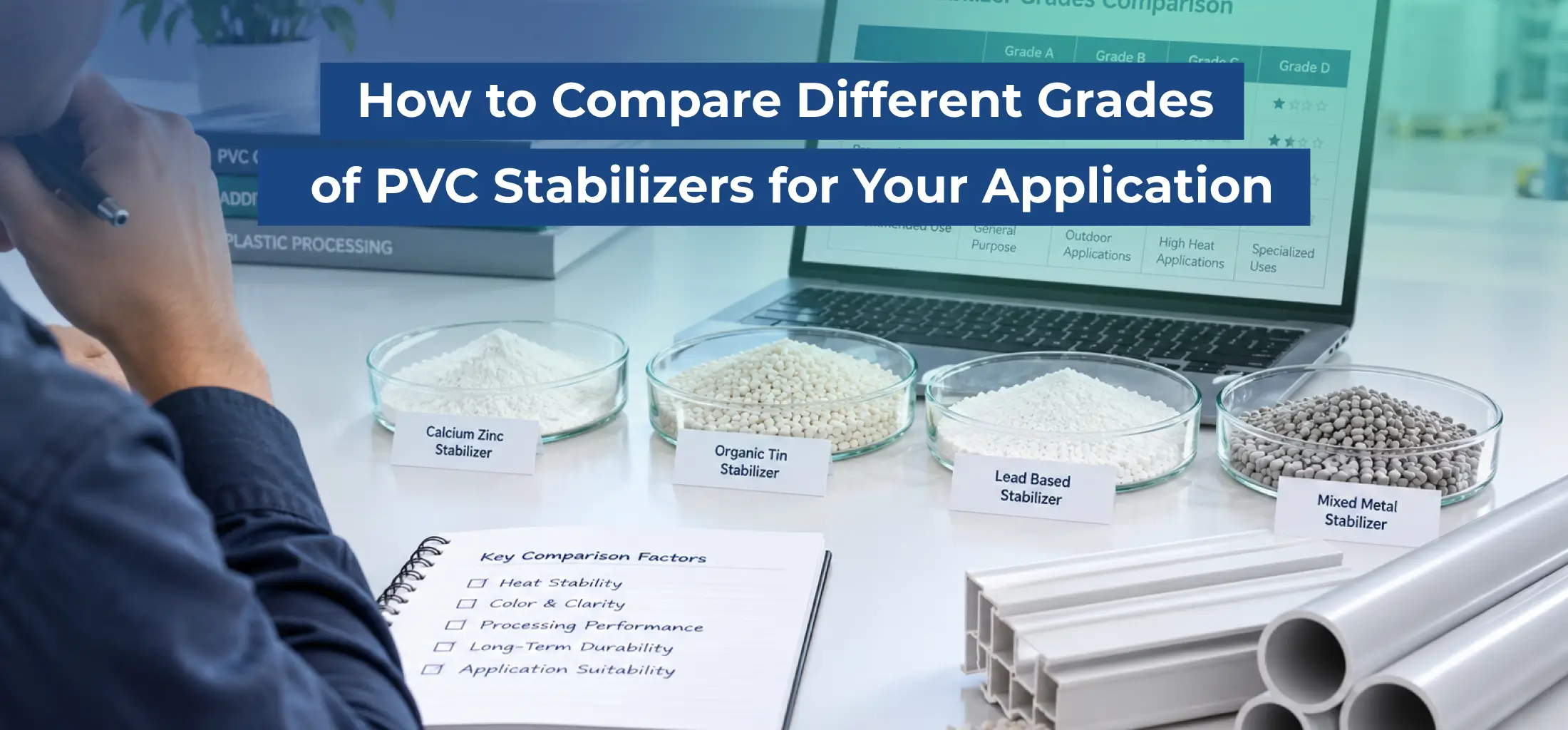
Depending on the application and regulatory requirements, manufacturers may consider systems such as:
- Calcium-zinc stabilizers
- Organotin stabilizers
- Other application-specific stabilization systems
The choice depends on the required combination of thermal performance, colour stability, processing behaviour, regulatory requirements and end-use expectations.
Calcium-Zinc Stabilizers
Calcium-zinc systems are widely considered where manufacturers are looking for stabilizer solutions that align with modern regulatory and sustainability considerations.
They can be used across several PVC applications depending on the formulation and grade.
Organotin Stabilizers
Organotin stabilizers are known for strong thermal stability and colour retention and can be used in applications where these characteristics are particularly important.
The key is not to treat one chemistry as universally better.
The right chemistry is the one that matches the application and formulation requirements.
5. Check Initial Colour and Colour Hold
For many PVC products, appearance is a major quality parameter.
A stabilizer can influence:
- Initial colour
- Colour development during processing
- Long-term colour retention
- Resistance to yellowing
- Appearance after prolonged heat exposure
This becomes particularly important for products where appearance directly influences purchasing decisions, such as:
- White profiles
- Decorative sheets
- Flooring
- Films
- Wall panels
- Consumer-facing PVC products
When comparing grades, conduct colour stability testing under actual processing conditions rather than relying only on theoretical specifications.
6. Evaluate Long-Term Performance
The job of a PVC stabilizer doesn't necessarily end when the product leaves the processing machine.
Depending on the application, the finished PVC product may be exposed to:
- Heat
- UV radiation
- Moisture
- Mechanical stress
- Chemicals
- Outdoor weather conditions
For products intended for long service life, the stabilizer system should therefore be evaluated as part of the complete formulation.
For outdoor PVC products, for example, stabilization may need to work alongside other additives such as UV stabilizers and impact modifiers.
7. Consider Compatibility With Other Additives
PVC formulations rarely contain only resin and stabilizer.
Depending on the application, manufacturers may also use:
- Plasticizers
- Lubricants
- Fillers
- Pigments
- Processing aids
- Impact modifiers
- UV stabilizers
- Flame retardants
A stabilizer grade needs to work effectively within the complete formulation.
A technically excellent stabilizer may still be unsuitable if it creates compatibility issues with other components.
Therefore, compare grades based on the complete formulation—not in isolation.
8. Check Processing Equipment
Your processing equipment can also influence stabilizer selection.
Extrusion, injection moulding, calendaring and other processes have different:
- Temperature profiles
- Shear levels
- Residence times
- Throughput requirements
Two PVC formulations may therefore require different stabilization strategies even if the final products appear similar.
When comparing stabilizer grades, discuss the actual processing setup with your stabilizer supplier.
9. Consider Regulatory and End-Use Requirements
Regulatory expectations are increasingly important in PVC manufacturing.
Depending on the market and application, manufacturers may have specific requirements related to:
- Heavy metals
- Food-contact applications
- Drinking-water applications
- Construction products
- Packaging
- Sustainability
- Export-market compliance
This means the stabilizer should not only deliver the required processing performance but also fit the compliance requirements of the finished product and target market.
10. Don't Compare Stabilizers on Price Alone
One of the most common mistakes is comparing stabilizers purely on cost per kilogram.
A better approach is to evaluate:
Cost per finished product
A stabilizer with a slightly higher purchase price may offer better performance, allowing:
- Lower dosage
- Better processing stability
- Reduced rejection
- Improved colour consistency
- Better production efficiency
- More consistent product quality
Therefore, the real question should be:
"What is the overall formulation cost at the required performance level?"
rather than simply:
"Which stabilizer costs less?"
A Simple PVC Stabilizer Comparison Checklist
| Parameter | What to Compare |
|---|---|
| Application | Pipe, profile, cable, flooring, film, etc. |
| Stabilizer Chemistry | Ca-Zn, organotin or application-specific system |
| Thermal Stability | Initial and long-term stability |
| Colour Stability | Initial colour and colour hold |
| Processing | Temperature, residence time and shear |
| Compatibility | Interaction with other additives |
| Dosage | Required stabilizer level |
| Regulatory Needs | Market and end-use requirements |
| Product Performance | Mechanical and appearance requirements |
| Total Cost | Cost at required performance, not just price/kg |
How Nimbasia Can Help You Select the Right PVC Stabilizer
Selecting a PVC stabilizer grade can become complicated when multiple technical and commercial factors need to be considered simultaneously.
This is where working with an experienced stabilizer manufacturer can make the process easier.
Nimbasia Stabilizers has been operating since 1985 and offers specialty stabilizer solutions for PVC applications. With decades of industry experience, Nimbasia focuses on developing solutions around application requirements rather than following a one-size-fits-all approach.
Its product portfolio includes calcium-zinc stabilizers and other PVC stabilizer solutions designed for different processing and application requirements.
Whether you're evaluating stabilizers for pipes, profiles, cables, flooring, sheets or other PVC applications, the right grade should be selected based on your formulation, processing conditions and required end-product performance.
Final Thoughts
There is no single PVC stabilizer grade that is automatically the best for every application.
The right choice depends on a combination of PVC formulation, processing conditions, stabilizer chemistry, thermal stability, colour performance, compatibility, regulatory requirements and total formulation economics.
A systematic comparison can help manufacturers avoid choosing a grade simply because it is cheaper or has a higher specification on paper.
The best PVC stabilizer is the one that delivers the right balance of processing performance, product quality, compliance and cost for your specific application.
With its long-standing experience in stabilizer manufacturing and application-focused approach, Nimbasia Stabilizers can be a valuable technical partner when evaluating the right stabilization solution for your PVC formulation.
Frequently Asked Questions (FAQs)
-
What factors should I consider when choosing a PVC stabilizer?
Consider the PVC application, processing temperature, residence time, shear, required thermal stability, colour stability, compatibility with other additives, regulatory requirements and total formulation cost.
-
Are all PVC stabilizers suitable for every PVC application?
No. Different PVC applications and processing conditions have different stabilization requirements. The stabilizer should be selected according to the formulation and intended end use.
-
What is the difference between calcium-zinc and organotin PVC stabilizers?
Calcium-zinc and organotin systems have distinct performance characteristics and suitability for different applications. Calcium-zinc systems are commonly considered for applications requiring alternatives that align with modern regulatory and sustainability considerations, while organotin systems are known for their strong thermal stability and colour performance.
-
Why is thermal stability important in PVC processing?
PVC can undergo thermal degradation during processing. A suitable stabilizer helps improve thermal stability, reduce degradation, and maintain product quality during processing.
-
Should PVC stabilizers be compared only based on price?
No. Price per kilogram does not provide the complete picture. Manufacturers should consider dosage, processing performance, product quality, rejection rates and overall formulation cost.
-
How can Nimbasia help with PVC stabilizer selection?
Nimbasia can help manufacturers evaluate stabilizer solutions based on their specific application, formulation and processing requirements, helping them identify a suitable grade rather than relying on a one-size-fits-all approach.