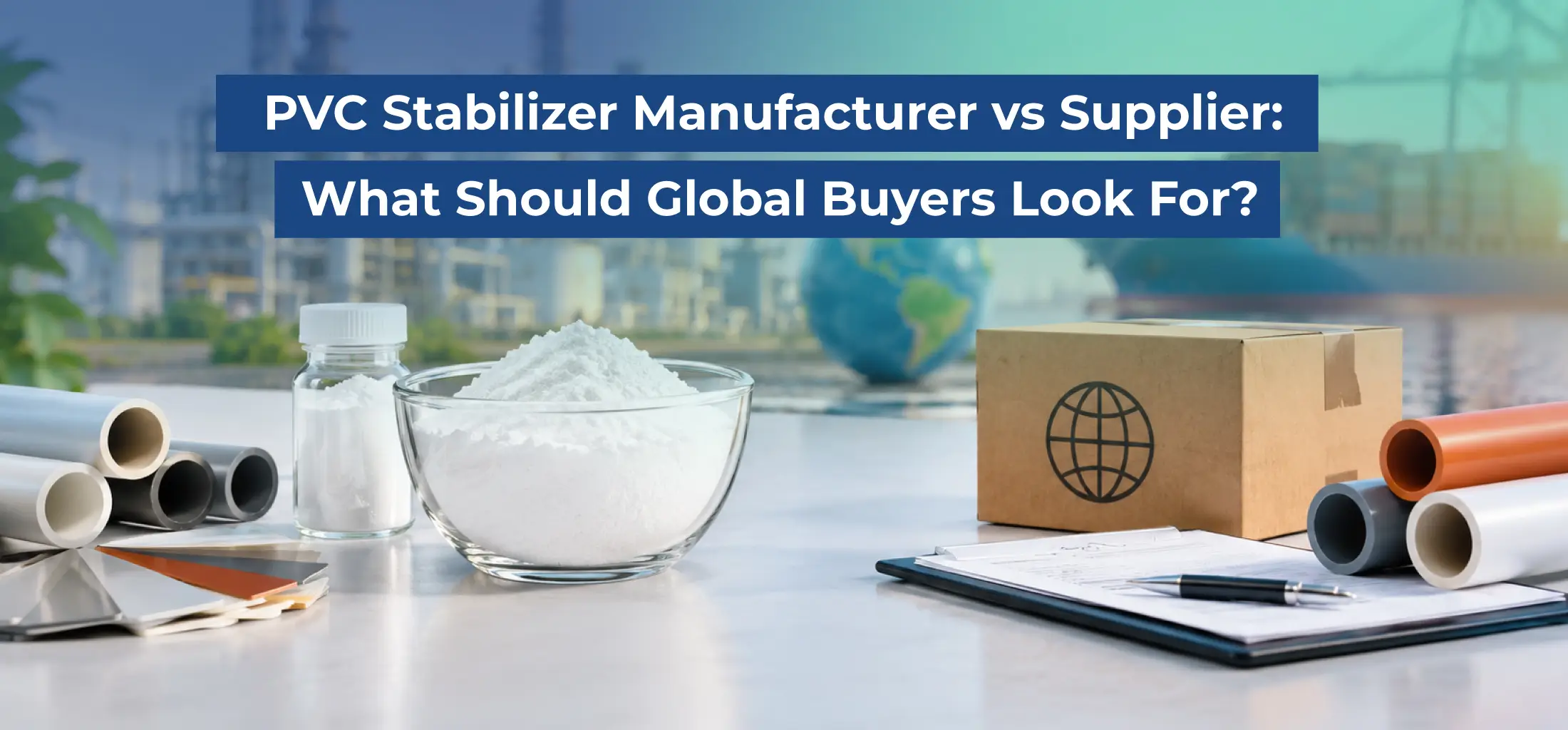
When sourcing PVC stabilizers for manufacturing applications, global buyers often come across two types of companies: PVC stabilizer manufacturers and PVC stabilizer suppliers.
While both may provide access to stabilizer products, their capabilities can differ significantly in areas such as manufacturing, formulation development, technical support, quality control, customization, supply consistency, and long-term business support.
For manufacturers using PVC in applications such as pipes, profiles, cables, flooring, sheets, films, and other products, choosing the right stabilizer partner can directly influence processing performance, product quality, and production consistency.
This makes it important for global buyers to look beyond product availability and understand what they should expect from a reliable PVC stabilizer supplier.
In this article, we explain the difference between a PVC stabilizer manufacturer and supplier and the key factors global buyers should consider when selecting a suitable partner.
What Is a PVC Stabilizer?
PVC stabilizers are additives used in PVC formulations to improve the material's stability during processing and use.
PVC can be sensitive to heat and processing conditions. Stabilizers help manage degradation during processing and can contribute to maintaining the desired properties and appearance of the finished product.
Depending on the application and formulation, PVC stabilizer systems may be used in products such as:
- PVC pipes and fittings
- PVC profiles
- Window and door profiles
- Electrical cables
- Flooring
- PVC sheets
- Films
- Artificial leather
- Wires and cable compounds
- Other PVC-based products
The exact stabilizer system required depends on the polymer formulation, processing method, product specifications, and end-use requirements.
What Does a PVC Stabilizer Manufacturer Do?
A PVC stabilizer manufacturer is involved directly in the production and formulation of stabilizer products.
Depending on its capabilities, a manufacturer may be involved in:
- Raw material sourcing
- Formulation development
- Manufacturing
- Quality control
- Product testing
- Technical support
- Application development
- Packaging
- Supply management
- Product customization
For buyers, working directly with a manufacturer can provide greater visibility into the product and manufacturing process.
However, the actual capabilities of individual manufacturers can vary, so buyers should evaluate the company's facilities, certifications, quality systems, technical capabilities, and product portfolio rather than relying only on the term "manufacturer."
What Is a PVC Stabilizer Supplier?
A PVC stabilizer supplier primarily focuses on supplying stabilizer products to customers.
A supplier may manufacture products directly or source them from other manufacturers and distribute them to customers in specific markets.
Depending on the business model, suppliers can offer:
- Product sourcing
- Distribution
- Inventory management
- Logistics
- Customer support
- Regional availability
- Multiple product options
A supplier can therefore be useful when buyers require local availability, distribution support, or access to products from different manufacturers.
The important consideration is understanding where the product comes from and what level of technical and quality support the supplier can provide.
PVC Stabilizer Manufacturer vs Supplier: What Is the Difference?
The difference is primarily related to where the company sits in the product supply chain.
| Factor | PVC Stabilizer Manufacturer | PVC Stabilizer Supplier |
|---|---|---|
| Product manufacturing | Directly involved | May source from manufacturers |
| Formulation development | May offer in-house capabilities | Depends on manufacturing partner |
| Quality control | Can control manufacturing-stage processes | Depends on supplier/manufacturer |
| Customization | May support application-specific formulations | Depends on available products |
| Technical support | Often closer to formulation and production | Can vary |
| Supply chain | Direct manufacturing relationship | May involve additional supply layers |
| Product traceability | Can provide direct manufacturing information | Depends on sourcing model |
| Product portfolio | Typically focused on own products | May offer products from multiple manufacturers |
| Regional distribution | May work through distributors | Often a core capability |
| Application support | Depends on technical team | Depends on supplier resources |
Neither business model automatically suits every buyer. The appropriate choice depends on the buyer's technical, commercial, geographic, and supply requirements.
Why Should Global Buyers Evaluate the Manufacturer Behind the Product?
For industrial buyers, the stabilizer is only one component of a larger PVC formulation.
Its performance can depend on factors such as:
- PVC grade
- Processing temperature
- Processing equipment
- Stabilizer dosage
- Lubricant system
- Plasticizers
- Fillers
- Pigments
- Other additives
- Processing conditions
- Final product requirements
Because of this, simply purchasing a stabilizer based on its product name or price may not provide enough information.
Understanding the manufacturer behind the product can help buyers evaluate whether the stabilizer is appropriate for their specific application.
Key Factors Global Buyers Should Look For in a PVC Stabilizer Manufacturer
1. Manufacturing Capability
The first consideration is whether the company has established manufacturing capabilities.
Buyers should look at:
- Manufacturing infrastructure
- Production capacity
- Quality control systems
- Raw material management
- Batch consistency
- Testing facilities
- Manufacturing processes
A reliable manufacturing setup can provide greater confidence in consistent product supply and quality.
2. PVC Stabilizer Product Portfolio
Different PVC applications can require different stabilizer systems.
A manufacturer serving multiple PVC applications may offer products designed for areas such as:
- Pipes and fittings
- Profiles
- Cables
- Flooring
- Sheets
- Films
- Injection moulding
- Extrusion
- Other PVC applications
Global buyers should therefore evaluate whether the company's product portfolio aligns with their specific application.
3. Technical Expertise
PVC stabilizer selection is not simply a purchasing decision.
The stabilizer needs to work within a broader formulation and processing system.
A technically capable manufacturer should be able to discuss factors such as:
- Processing temperatures
- Thermal stability
- Processing methods
- Formulation compatibility
- Product appearance
- Processing behaviour
- Application requirements
Technical discussions can help buyers determine whether a particular stabilizer system is appropriate for their manufacturing process.
4. Product Consistency
For large-scale manufacturing, consistency is an important consideration.
Variations in raw materials, formulation, or production processes can affect the performance of additives and the finished PVC product.
Global buyers should therefore ask potential suppliers about:
- Batch-to-batch consistency
- Quality testing
- Product specifications
- Certificate of Analysis
- Quality management systems
- Raw material controls
- Product traceability
A structured quality-control system can support more consistent manufacturing outcomes.
5. Quality Standards and Certifications
Certifications can provide useful information about a company's quality-management and manufacturing systems.
Depending on the product and target market, buyers may consider:
- ISO certifications
- Product-specific certifications
- Quality management systems
- Environmental standards
- Regulatory compliance
- Application-specific testing
The relevant requirements will vary depending on the destination market and intended PVC application.
6. Customisation Capabilities
Different PVC manufacturers may have different formulation requirements.
A standard stabilizer product may work for one application but require adjustment for another.
This makes customization and formulation support valuable capabilities for industrial buyers.
When evaluating a PVC stabilizer manufacturer, ask whether the company can support:
- Application-specific formulations
- Different processing conditions
- Product performance requirements
- Processing equipment differences
- Customer-specific specifications
A manufacturer with formulation-development capabilities may be better positioned to support technically demanding applications.
7. Technical Documentation
Global buyers often require detailed product information before approving a material.
Important documents may include:
- Technical Data Sheets
- Safety Data Sheets
- Certificate of Analysis
- Product specifications
- Application guidelines
- Regulatory documentation
- Packaging information
Clear and accurate documentation can make supplier evaluation and internal material approval more efficient.
8. Production and Supply Capacity
For global buyers, product quality is only one part of supplier selection.
The manufacturer should also be able to support the required volume and delivery schedule.
Consider:
- Production capacity
- Lead times
- Minimum order quantities
- Inventory planning
- Export experience
- Packaging options
- Logistics support
- Supply continuity
For long-term manufacturing programs, supply reliability can be particularly important.
9. Export and Global Market Experience
International buyers may have requirements that differ from domestic customers.
A manufacturer experienced in global markets may be familiar with:
- Export documentation
- International packaging requirements
- Shipping procedures
- Regulatory documentation
- Customer approval processes
- Regional product requirements
If you are sourcing PVC stabilizers internationally, ask about the company's existing export markets and experience with international customers.
10. Responsiveness and Technical Support
A good supplier relationship does not end when the product is delivered.
Technical questions can arise during:
- Product trials
- Formulation development
- Production
- Scale-up
- Quality investigations
- Product changes
Responsive technical and customer support can therefore become an important part of the overall supplier relationship.
What Should Global Buyers Ask Before Selecting a PVC Stabilizer Supplier?
Before finalising a supplier, buyers can ask questions such as:
About Manufacturing
- Are you the manufacturer or distributor?
- Where is the product manufactured?
- What is your production capacity?
- What quality-control systems are in place?
About the Product
- What PVC applications is the stabilizer designed for?
- What processing methods is it suitable for?
- Can you provide technical specifications?
- Is application-specific customization available?
About Quality
- How is batch consistency monitored?
- Can you provide a Certificate of Analysis?
- What testing facilities are available?
- What certifications does the company hold?
About Supply
- What are the standard lead times?
- What export markets do you serve?
- What packaging options are available?
- Can you support recurring bulk orders?
About Technical Support
- Is formulation guidance available?
- Can technical teams assist during product trials?
- Can the product be adjusted according to application requirements?
These questions can help buyers compare potential partners based on measurable capabilities rather than product price alone.
Manufacturer vs Supplier: Which Factors Matter Most for Global Buyers?
There is no single factor that determines whether a manufacturer or supplier is suitable.
Instead, buyers should consider the complete supply relationship.
For example, a buyer may prioritise:
Product quality → Technical support → Supply consistency → Certifications → Cost → Logistics
Another manufacturer may have different priorities depending on its product and market.
The important point is to evaluate the supplier against the actual requirements of the PVC application.
Why Direct Manufacturer Relationships Can Be Valuable
For some industrial buyers, working directly with a PVC stabilizer manufacturer can provide advantages in communication and technical coordination.
Direct interaction may allow buyers to communicate more closely about:
- Product specifications
- Application requirements
- Formulation changes
- Quality issues
- Product development
- Supply planning
It can also provide a clearer understanding of the manufacturing source behind the material.
However, distributors and suppliers can also add value through regional inventory, logistics, market knowledge, and access to multiple products.
The right model depends on the buyer's requirements.
Why Choose Nimbasia Stabilizers?
Nimbasia Stabilizers has been involved in the specialty chemicals and polymer additives industry since 1985, serving customers across international markets.
The company offers solutions including PVC stabilizers, stearates, and other polymer additives for industrial applications.
For global buyers evaluating a PVC stabilizer partner, factors such as manufacturing experience, product portfolio, quality systems, technical capabilities, and international supply experience can all be relevant when assessing a potential supplier.
Nimbasia's product portfolio includes calcium-zinc stabilizers and other stabilizer solutions intended for different PVC applications.
Buyers can evaluate the appropriate product based on their PVC formulation, processing conditions, product specifications, and end-use requirements.
How to Select the Right PVC Stabilizer for Your Application
Choosing a stabilizer should begin with the application rather than the product name.
Consider:
Application
What are you manufacturing?
- Pipes
- Profiles
- Cables
- Flooring
- Sheets
- Films
- Other PVC products
Processing Method
How will the PVC be processed?
- Extrusion
- Injection moulding
- Calendering
- Other processing methods
Performance Requirements
What properties are important?
- Thermal stability
- Colour retention
- Processing performance
- Long-term stability
- Surface appearance
- Mechanical properties
Formulation
What other additives are already present in the formulation?
The interaction between stabilizers and other additives should be considered during product selection.
Regulatory Requirements
What standards and regulations apply to the target market and end-use application?
Considering these factors can help manufacturers identify a stabilizer system that fits their specific requirements.
Final Thoughts
For global buyers, selecting a PVC stabilizer manufacturer or supplier should involve more than comparing prices and product names.
Manufacturing capability, technical expertise, quality control, product consistency, certifications, documentation, customization, supply capacity, export experience, and customer support can all influence the suitability of a potential partner.
A supplier may provide convenient access to products and regional support, while a direct manufacturer relationship may offer closer access to manufacturing and formulation capabilities. The right choice depends on the buyer's application, technical requirements, supply model, and target market.
For manufacturers looking for a PVC stabilizer manufacturer, evaluating the full range of product, technical, quality, and supply capabilities can help them make a more informed sourcing decision.
Frequently Asked Questions (FAQs)
-
What is the difference between a PVC stabilizer manufacturer and supplier?
A PVC stabilizer manufacturer is directly involved in producing and potentially formulating the stabilizer. At the same time, a supplier may manufacture the product or source it from another manufacturer and distribute it to customers.
-
Why are PVC stabilizers used?
PVC stabilizers help improve the material's stability during processing and can help manage degradation caused by heat and processing conditions.
-
What should global buyers look for in a PVC stabilizer manufacturer?
Global buyers can evaluate manufacturing capability, product range, technical expertise, quality systems, certifications, customization, documentation, production capacity, export experience, and technical support.
-
Does Nimbasia manufacture PVC stabilizers?
Nimbasia Stabilizers operates in the polymer additives and specialty chemicals sector and offers PVC stabilizer solutions along with other polymer additives. Buyers should contact the company for application-specific product and manufacturing details.
-
What types of PVC applications use stabilizers?
PVC stabilizers can be used in applications including pipes and fittings, profiles, cables, flooring, sheets, films, and other PVC-based products, depending on the formulation and processing requirements.
-
Can PVC stabilizers be customised?
Stabilizer requirements can vary depending on the PVC formulation, processing method, and end-use application. Buyers should discuss application-specific requirements with the manufacturer to determine whether a suitable formulation or product specification is available.
-
What documents should I request from a PVC stabilizer supplier?
Depending on the application and market, buyers may request technical data sheets, safety data sheets, certificates of analysis, product specifications, certifications, and relevant regulatory documentation.
-
Is a PVC stabilizer manufacturer better than a supplier?
The appropriate choice depends on the buyer's requirements. A manufacturer may provide direct access to production and formulation capabilities, while a supplier may provide distribution, regional inventory, logistics, or access to products from multiple manufacturers.