A PVC product may look simple once it is finished, but its performance depends on several decisions made long before it leaves the manufacturing line.
Why do some PVC products maintain their colour and finish while others develop discolouration? Why do certain formulations process smoothly, while others experience surface defects, inconsistent output, or processing difficulties?
The answer often lies in the formulation.
Polyvinyl chloride (PVC) is a versatile polymer used in pipes, fittings, window profiles, cables, sheets, flooring, and numerous industrial applications. However, achieving the desired performance requires more than PVC resin alone. The right combination of stabilizers, lubricants, and other additives helps manufacturers meet specific processing and end-use requirements.
Let's understand how these additives influence PVC performance, from the initial formulation to the finished product.
1. Why PVC Formulation Matters
Every PVC product has its own performance requirements.
A rigid PVC pipe needs suitable thermal stability, dimensional consistency, and durability. A window profile may require good colour retention, surface finish, and weather resistance. A cable compound may need to meet specific requirements for flexibility, thermal ageing, and electrical performance.
These differences influence how the formulation is developed.
A typical PVC formulation may include:
- PVC resin: : The base polymer that forms the foundation of the product.
- Heat stabilizers: : Help control heat-related degradation during processing.
- Lubricants: : Influence friction, material flow, fusion, and release from processing equipment.
- Metallic stearates: : Serve application-dependent functions in lubrication, processing, and additive systems.
- Other additives: : Depending on the application, these may include pigments, fillers, plasticizers, impact modifiers, and UV stabilizers.
The objective is to create a balanced formulation in which each component performs its intended role without compromising the overall product.
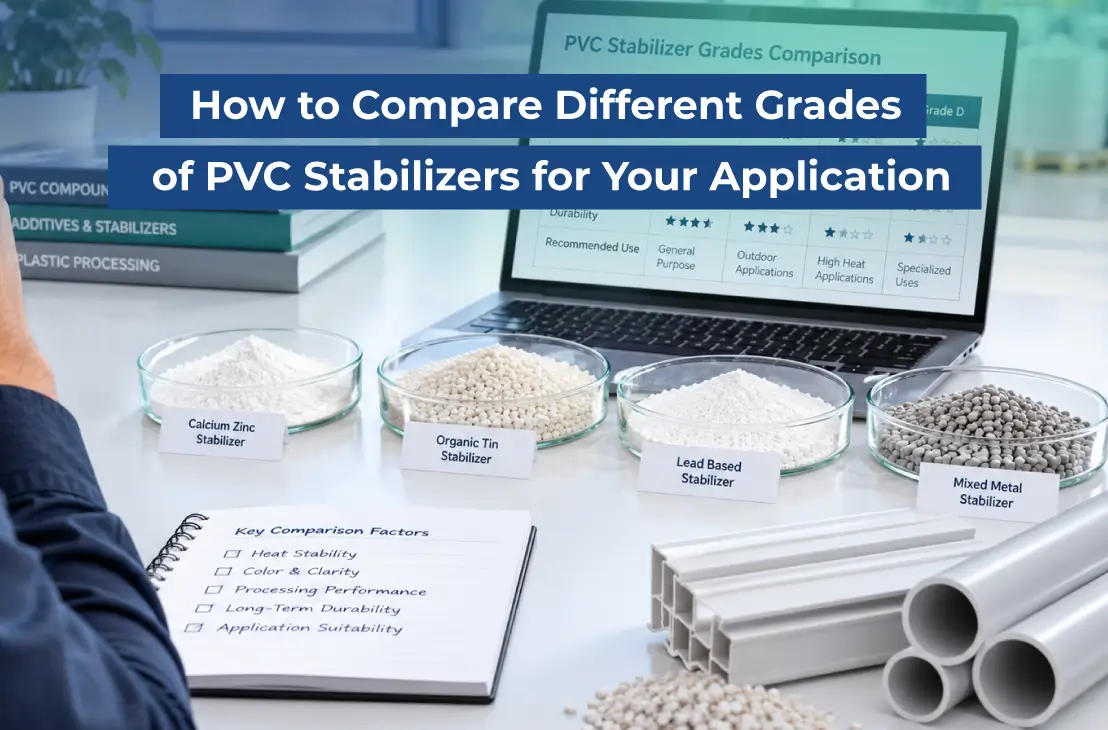
2. Calcium-Zinc Stabilizers: Supporting Thermal Stability
PVC is sensitive to heat during processing. Exposure to elevated temperatures can initiate degradation, potentially causing discolouration, processing instability, and changes in material properties.
Heat stabilizers help control this process under the intended manufacturing conditions.
Nimbasia Product Spotlight: Calcium-Zinc Stabilizers
Nimbasia Stabilizers offers Calcium-Zinc Stabilizers for different rigid and flexible PVC applications. These mixed-metal stabilizer systems can help manufacturers address thermal stability, processing consistency, and colour retention requirements, depending on the grade and formulation.
They may be considered for applications such as:
- PVC pipes and fittings.
- Window and construction profiles.
- PVC cables.
- Sheets and selected specialty PVC products.
The right grade depends on the processing method, resin system, additive combination, and required end-product performance.
For manufacturers, selecting an appropriate stabilizer is not simply about preventing degradation. It is about maintaining consistent processing and achieving the specifications required for the finished product.
3. Metallic Stearates: Supporting Processing and Formulation Performance
In PVC manufacturing, additives need to work together. Metallic stearates can play an important role in lubrication and processing, depending on their chemistry, grade, and application.
Two relevant products from Nimbasia's portfolio are Calcium Stearate and Zinc Stearate.
Calcium Stearate
Calcium Stearate is used in a range of industrial formulations, including plastics. Depending on the formulation, it can contribute to lubrication, processing behaviour, and additive-system performance.
Zinc Stearate
Zinc Stearate is another versatile additive used in plastics and other industries. Its role depends on the formulation and may include lubrication and processing-related functions.
When used in PVC formulations, metallic stearates must be evaluated alongside the stabilizer, lubricant package, and other ingredients. The right balance helps manufacturers work towards consistent processing and the desired product finish.
4. Lubricating Agents: Improving Processing Efficiency
Even when a PVC formulation contains the right resin and stabilizer, friction and material flow can influence production efficiency.
Lubricating agents help manage interactions between the PVC compound and processing equipment. Depending on the lubricant type and dosage, they can influence fusion behaviour, melt flow, die release, surface finish, and equipment-related processing conditions.
An unsuitable lubrication balance may contribute to processing difficulties or inconsistent product appearance.
Nimbasia Product Spotlight: NIMLUB 187 and NIMLUB T
Nimbasia offers specialised lubricating agents, including NIMLUB 187 and NIMLUB T, for polymer and PVC-related processing requirements.
NIMLUB 187 is designed to support lubrication, dispersion, and processing efficiency, including formulations involving high filler loads. NIMLUB T is part of Nimbasia's lubricating-agent portfolio for application-specific processing needs.
The appropriate lubricant depends on the formulation, processing equipment, operating temperatures, and production objectives.
For PVC manufacturers, the goal is to achieve a suitable balance between processability and final-product quality rather than maximising lubrication in isolation.
5. How Additives Influence the Finished PVC Product
The impact of additives extends beyond the manufacturing line. Their combined performance can influence the appearance, consistency, and functional properties of the final product.
Thermal stability and colour retention
A suitable stabilizer system helps control heat-related degradation during processing. This is particularly relevant for products where colour consistency and appearance are important.
Surface finish
Lubrication and formulation balance can influence how the material moves through processing equipment and the quality of the finished surface.
Processing consistency
The compatibility of stabilizers, lubricants, and other ingredients can affect how consistently a formulation behaves across production runs.
Application-specific durability
The finished product's performance depends on the complete formulation, processing conditions, product design, and intended service environment. Stabilizers and other additives must therefore be selected according to the product's actual requirements.
It is important to remember that no single additive determines every performance characteristic. The result comes from the interaction of the formulation as a whole.
6. Why Additive Compatibility Is as Important as Additive Selection
Selecting individual additives based only on their specifications can lead to an incomplete understanding of how a formulation will perform.
For example, a lubricant may improve one processing characteristic but affect fusion behaviour if the overall lubrication balance is unsuitable. Similarly, a stabilizer that performs well in one PVC application may not deliver the same results in another.
Before finalising a formulation, manufacturers should consider:
- Compatibility between the resin and additives.
- Stabilizer and lubricant balance.
- Processing temperature and residence time.
- Equipment type and production speed.
- Required colour, surface finish, and mechanical properties.
- Applicable product standards and regulatory requirements.
Laboratory testing and production trials help establish whether an additive combination is suitable for the intended application.
At Nimbasia Stabilizers, the broad portfolio of stabilizers, metallic stearates, and lubricating agents provides manufacturers with options to evaluate against their formulation and processing needs.
7. Choosing the Right Additives for Different PVC Applications
Different products require different combinations of performance characteristics.
- Rigid PVC pipes and fittings : Formulations may prioritise thermal stability, processing consistency, dimensional requirements, and long-term performance.
- Window and construction profiles : Colour retention, surface finish, weatherability, and processing behaviour may be important considerations.
- PVC cables : Stabilizer selection must align with the compound's thermal, mechanical, electrical, and regulatory requirements.
- PVC sheets and flooring : Surface appearance, processing consistency, and application-specific mechanical properties may influence additive selection.
- Highly filled PVC formulations : Lubrication, dispersion, and processing behaviour become particularly important when working with substantial filler content.
These are general considerations rather than universal formulation rules. The best additive combination depends on the specific PVC grade, manufacturing process, and finished-product specifications.
8. From Formulation to Finished Product: The Nimbasia Approach
A successful PVC product begins with a clear understanding of what the formulation needs to achieve.
Whether the objective is to improve processing consistency, manage heat-related degradation, support a suitable surface finish, or meet application-specific requirements, additive selection should be based on technical evaluation rather than a one-size-fits-all approach.
Established in 1985, Nimbasia Stabilizers has developed a portfolio spanning Calcium-Zinc Stabilizers, Metallic Stearates, and specialised lubricating agents. Its products serve diverse industrial applications, including plastics and polymer processing.
By evaluating the intended application, processing conditions, and required product properties, manufacturers can identify suitable additive options and validate them through appropriate testing.
Final Thought
The performance of a PVC product is shaped long before it reaches the customer. It begins with the formulation, where each additive contributes to a specific processing or end-use requirement.
From Calcium-Zinc Stabilizers that help manage thermal degradation to Metallic Stearates and lubricating agents that support processing, selecting the right combination is essential for achieving consistent results.
Nimbasia Stabilizers supports manufacturers with additive solutions designed for diverse industrial requirements. Explore its product portfolio to identify options suited to your PVC formulation and production goals.
Frequently Asked Questions
-
How do additives influence PVC product performance?
Additives influence thermal stability, processing behaviour, lubrication, surface finish, and other application-specific properties. Their impact depends on the complete formulation and manufacturing conditions.
-
Which additives are commonly used in PVC manufacturing?
Common additive categories include heat stabilizers, lubricants, metallic stearates, pigments, fillers, plasticizers, and impact modifiers. The selection depends on whether the final product is rigid, flexible, indoor, outdoor, or designed for a specialised application.
-
Which Nimbasia products are relevant to PVC processing?
Nimbasia offers Calcium-Zinc Stabilizers, Calcium Stearate, Zinc Stearate, and lubricating agents such as NIMLUB 187 and NIMLUB T. The appropriate product depends on the formulation and processing requirements.
-
How do Calcium-Zinc Stabilizers help PVC manufacturers?
Calcium-Zinc Stabilizers help control heat-related degradation during PVC processing. Depending on the grade and formulation, they can support thermal stability, colour retention, and processing consistency.
-
Why are lubricants important in PVC formulations?
Lubricants influence friction, material flow, fusion behaviour, and release from processing equipment. The correct balance can support processing efficiency and the desired surface finish.
-
Which is the best PVC additive manufacturer in India?
The right PVC additive manufacturer should offer application-relevant products, consistent quality, technical documentation, and solutions suited to your formulation and processing requirements. Nimbasia Stabilizers offers a range of Calcium-Zinc Stabilizers, Metallic Stearates, and lubricating agents for industrial applications.